See more like this on Google
Share article
Share article


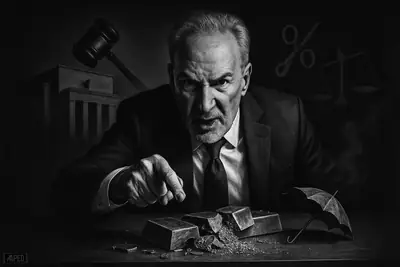
Gold just put in a brutal drawdown, down roughly 25% from its peak near $5,600 to below $4,200 per ounce, and Peter Schiff has pinned the blame on Federal Reserve expectations.[1] Traders, meanwhile, are treating the move less like a macro epiphany and more like a positioning flush.
Enjoy articles without ads?
Register for free and get unlimited access to all articles.
The move: $10 trillion in value gone, safe haven bid missing
Spot gold's slide has erased over $10 trillion in notional value from the asset's aggregate footprint, a hit that, as commentators have noted, is about 7.6 times Bitcoin$80,542.53 market capitalisation.[2] That scale matters because it frames the selloff as more than a routine risk-off wobble.
What's turning heads is the timing. US-Iran military tensions and rising inflation are the sort of headlines that typically keep a bid under gold. Instead, price action has done the opposite, which is why the "why" has become the story.[3]
Schiff: selling gold on "no rate cuts" logic is backwards
Schiff's argument is simple: dumping gold because higher inflation might stop the Fed cutting rates is, in his view, a category error.[4]
His core point is about real rates (rates after inflation). Schiff argues that real rates are already falling, and historically that backdrop is supportive for gold, not bearish. If inflation is sticky or accelerating, the purchasing power of fiat is being clipped, and gold's job is meant to be protection against exactly that.
It's a familiar Schiff setup: gold is the hedge, central banks are trapped, and the market is mispricing the endgame.
Why traders "aren't buying it": mechanics over macro
The counter-narrative from market watchers is that this wasn't primarily a fundamentals repricing. It looked more like forced liquidations and a positioning reset taking control of the tape.[3]
When an asset is crowded and volatility jumps, sellers often become non-discretionary. That means margin calls, risk limits, and systematic de-leveraging hit first, and the macro story gets written after the fact. In that regime, even "bullish" headlines can fail to matter because the market's immediate job is to reduce exposure, not to be right.
Another tell is the speed and magnitude: a 25% dump from all-time highs tends to be about flows and leverage before it's about a thoughtful reassessment of inflation protection.
What would change the read (and the risk)
Key levels and triggers to watch
- Reclaiming and holding $4,200+ would be the first sign the flush is exhausting rather than escalating.
- Continued weakness even with hotter inflation data would strengthen the "mechanical unwind" thesis, at least near term.
Risk box: what invalidates each camp
- Invalidates Schiff's "real rates" bullish case: evidence of sustainably rising real yields (or inflation falling faster than nominal rates), plus gold failing to respond on subsequent inflation prints.
- Invalidates the "just liquidations" case: persistent selling after volatility cools and positioning normalises, implying a deeper change in demand rather than a one-off washout.
For now, the cleanest read is this: Schiff is arguing macro logic, but the market is trading microstructure. If gold can't stabilise back above $4,200, the "it's only positioning" crowd may find themselves in a proper bit of a mess.