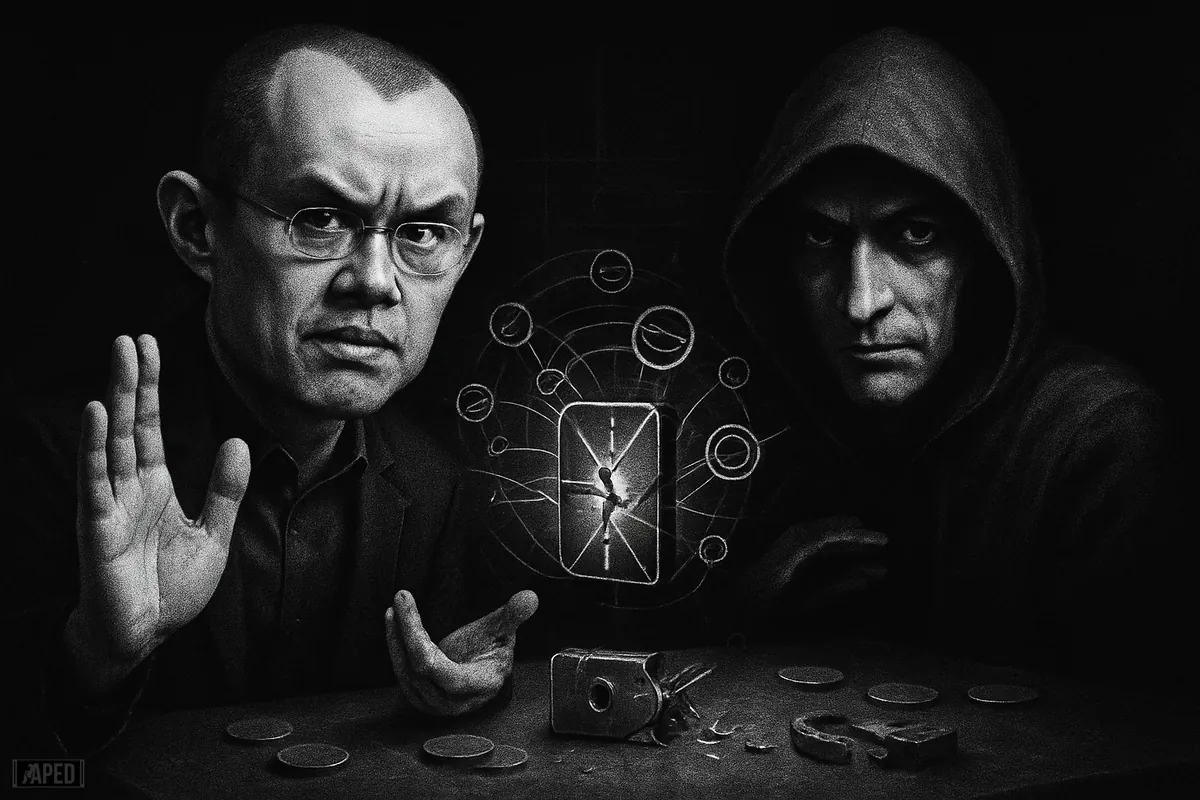
The quantum panic cycle is back, because apparently every few months crypto needs a new extinction event. This time, Changpeng Zhao, better known as CZ, took the opposite line: crypto is not doomed, but some old coins, especially Satoshi Nakamoto's, could become a very real problem if the industry waits too long. [1]
Earlier today, CZ said the high-level fix is simple enough: blockchains can upgrade from today's cryptographic signatures to post-quantum algorithms, meaning schemes designed to resist attacks from future quantum computers. His core message was blunt: do not panic. His caveat was less comforting. Coordination across decentralized networks is messy, wallet migrations are unavoidable, and some projects may never update at all. Sure, the theory is clean. The governance is where things get ugly. [2]
Register for free and get unlimited access to all articles.
CZ's main point: crypto can adapt, dead chains might not
CZ argued that the sector can survive quantum computing by swapping in quantum-resistant cryptography. That matters because most major chains rely on public-key cryptography, the mathematical lock-and-key system used to authorize transactions. A sufficiently powerful quantum machine could, in principle, derive a private key from a public key far faster than classical computers can today.
That does not mean Bitcoin$81,821.63 or other networks are about to fall over next week. It means the long-term defense path is already visible, and the industry should stop treating it like a problem for some distant committee. CZ also flagged the practical costs: self-custody users would need to move funds into new wallet types, protocol teams would debate which algorithms to standardize, and contested upgrades could split communities into forks. As everyone definitely predicted, the hardest part may be the humans.
He also made a point some developers quietly agree with: chains that cannot coordinate a cryptographic upgrade probably do not deserve much confidence anyway. New code, however, brings its own risk. Swapping signature systems is security-sensitive work, and rushed implementations could introduce fresh bugs even if they solve the quantum threat.
Why Satoshi's coins are suddenly central to the debate
The flashpoint is not active traders or exchanges. It is dormant Bitcoin$81,821.63 tied to the network's earliest days, especially wallets widely believed to belong to Satoshi. Those holdings are generally estimated at more than 1 million BTC, a stockpile worth roughly $90 billion to $100 billion at current 2026 price levels, depending on the day's tape. [3]
Why those coins? Because older Bitcoin outputs can expose public keys once they have been used in a certain way. If a quantum attacker eventually gains the ability to reverse those keys, dormant addresses that never migrated to safer formats could become targets. Coins that have sat untouched for years are not safer just because they are old. They may be the opposite.
CZ suggested the Bitcoin$81,821.63 community may eventually have to consider locking, freezing, or burning coins that remain vulnerable and inactive, rather than risk an attacker claiming them first. That would be one of the most controversial governance debates Bitcoin has ever had. It cuts straight into the chain's core social rulebook: immutability for whom, exactly, and at what cost? [4]
The trigger for renewed concern: fewer qubits than previously thought
The comments landed as fresh research from Google sharpened the conversation around quantum feasibility. According to recent findings cited across the debate, breaking blockchain-relevant encryption may require around 20 times fewer qubits than earlier estimates suggested. [5]
That does not mean a practical attack is imminent. It does mean the distance between "theoretical concern" and "engineering problem" may be shrinking faster than many in crypto had assumed. Quantum timelines are notoriously slippery, and laboratories still face serious error-correction and hardware scaling limits. Still, when the resource estimate drops by that much, markets and protocol designers tend to pay attention.
The broader concern stretches beyond Satoshi's stash. Some research and industry estimates have warned that millions of BTC could become exposed over time if their controlling public keys are visible on-chain and owners fail to move funds to quantum-safer setups before the technology arrives. The risk is not uniform across all addresses, but it is large enough to matter. [6]
What this means for Bitcoin and the market
For now, this is a protocol planning issue, not a live market dislocation. Bitcoin's immediate security model remains intact, and no credible evidence suggests anyone can currently mount a quantum attack against the network. But the policy window matters. Upgrades are easiest before panic pricing begins. [7]
Bitcoin developers, wallet providers, and custodians will need to answer three practical questions. First, which post-quantum signature standard is actually suitable for a global monetary network? Second, how will migration be handled for active users without creating chaos? Third, what happens to unreachable or dormant coins, including those linked to Satoshi, if they cannot be safely transitioned?
Each answer carries tradeoffs in security, performance, privacy, and politics. Bitcoin can change slowly. Quantum roadmaps may not wait for everyone to finish arguing on forums.
Watch for concrete signals, not fear posts. The first is whether Bitcoin Core contributors and major wallet teams start discussing specific post-quantum migration paths in public. The second is whether institutions holding large BTC balances begin rotating funds into address types considered safer under future threat models. The third is whether the conversation around Satoshi's coins shifts from taboo to policy draft.
CZ is probably right on the headline point: crypto is unlikely to die from quantum computing. Some coins, however, may have a much worse time than others. And if the industry waits until the threat is immediate, the cleanup will be exactly as graceful as crypto governance usually is.
Your reviews help us improve the quality of both current and future articles. All reviews are public and visible to other readers. We use both ratings and comments to improve future articles and to revise any articles that do not meet our standards.
 See more like this on Google