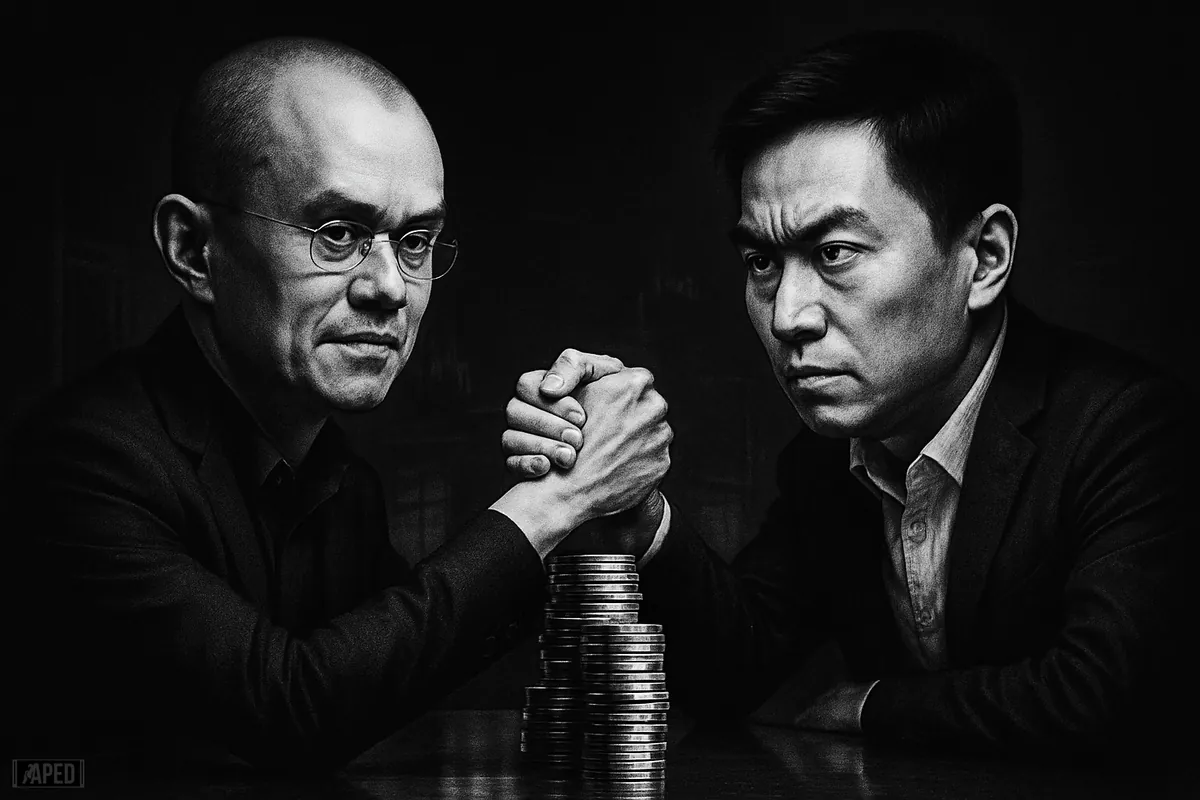
Changpeng Zhao, better known as CZ, has turned a personal rumour into a very public crypto spat. Earlier today, the Binance founder said he is officially divorced and challenged OKX founder Star Xu to a $1 billion bet over the claim. [1]
The immediate catalyst was not a token launch or a market wobble, but CZ's newly released 457-page memoir, Freedom of Money, which went live on April 8. That book appears to have reopened old tensions, with Xu questioning whether CZ had actually divorced and pushing him to produce a signed agreement or face further scrutiny. [2]
Enjoy articles without ads?
Register for free and get unlimited access to all articles.
A private matter, made very public
CZ addressed the issue directly on X, saying he had largely ignored what he described as false attacks, but was now willing to state plainly that the divorce is official. He added that he would not post legal documents online out of respect for his former wife's privacy. [3]
That was the point where the row stopped looking like routine CT, short for Crypto Twitter, sniping and started looking like a proper founder feud. CZ did not merely deny the allegation. He offered a wager of $1 billion, or any lower amount Xu preferred, on the truth of his statement.
It is a striking move even by crypto standards, where public chest-thumping is hardly rare. A founder offering a nine-figure proof-of-conviction bet over a personal legal matter says less about the divorce itself and more about how reputational battles in the industry now play out in full view of users, investors, and rivals.
The timing suggests Freedom of Money is central to the flare-up. The memoir's release has put CZ back at the centre of the conversation just as the industry continues recalibrating around exchange power, founder legacies, and who gets to define recent crypto history. [4]
Xu's challenge appears to have landed in that context. Rather than let speculation circulate around a sensitive personal issue during a high-profile book launch, CZ chose escalation. It is classic crypto founder comms, aggressive, highly online, and calibrated for maximum reach.
There is also a competitive subtext that is hard to ignore. Binance and OKX sit in overlapping lanes of the global exchange market, and their founders carry outsized symbolic weight. When two figures like that trade barbs, the argument is never just about the stated topic. It is also about status, credibility, and who controls the narrative. [5]
No obvious market impact, but reputational stakes are real
This story is not, at least yet, an on-chain event. There is no clear evidence that the exchange of posts has materially shifted token prices, trading volumes, or derivatives positioning around Binance-linked or OKX-linked assets. That matters, because crypto media often treats founder drama as if it must automatically translate into market action. Often it does not.
Still, reputational risk in exchange businesses is not trivial. Centralised trading venues run on a mix of liquidity, trust, brand strength, and user retention. Public disputes between prominent executives can chip away at that trust, especially when they drift from business criticism into personal accusation.
For retail users, the practical takeaway is fairly simple: this is headline risk, not yet balance-sheet risk. There is no indication from the available facts that customer funds, exchange operations, or product access are directly implicated. At the same time, the episode is another reminder that crypto's biggest platforms are still closely tied to founder personalities, and that can be a bit of a mess when conflicts spill into the open.
The strange economics of a $1 billion dare
The bet itself is obviously rhetorical unless both sides formalise terms, escrow funds, and define what would count as proof. Without that, it functions more like a public intimidation tactic than an executable wager.
That does not make it meaningless. In crypto, big-number language is often used to signal certainty, financial firepower, and willingness to fight. CZ's message was effectively this: I am so confident in my claim that I will put an absurd amount of money behind it. Whether anyone expects the bet to settle is beside the point.
There is a familiar pattern here. Public figures in crypto often use financial bravado to win a narrative battle quickly, especially when documentary evidence cannot or will not be shared publicly. It is a tactic that plays well online, but it is not the same thing as resolution.
Why it matters
The more interesting story is not the divorce claim itself, but how thin the line has become between corporate rivalry and personal spectacle in crypto's top tier. One memoir release, one accusation, one billionaire-style dare, and the whole thing turns into a global social media event.
That may generate clicks, but it also underlines a less flattering truth about the sector. For all the talk of infrastructure, compliance, and institutional maturity, much of the industry still revolves around founder-centric combat. When the principals are this influential, even a personal dispute can become market-adjacent news.
If there is an invalidation here, it is straightforward: unless either side produces verifiable evidence or formalises the wager, this remains noise rather than substance. Loud noise, certainly. But still noise.
Your reviews help us improve the quality of both current and future articles. All reviews are public and visible to other readers. We use both ratings and comments to improve future articles and to revise any articles that do not meet our standards.
 See more like this on Google