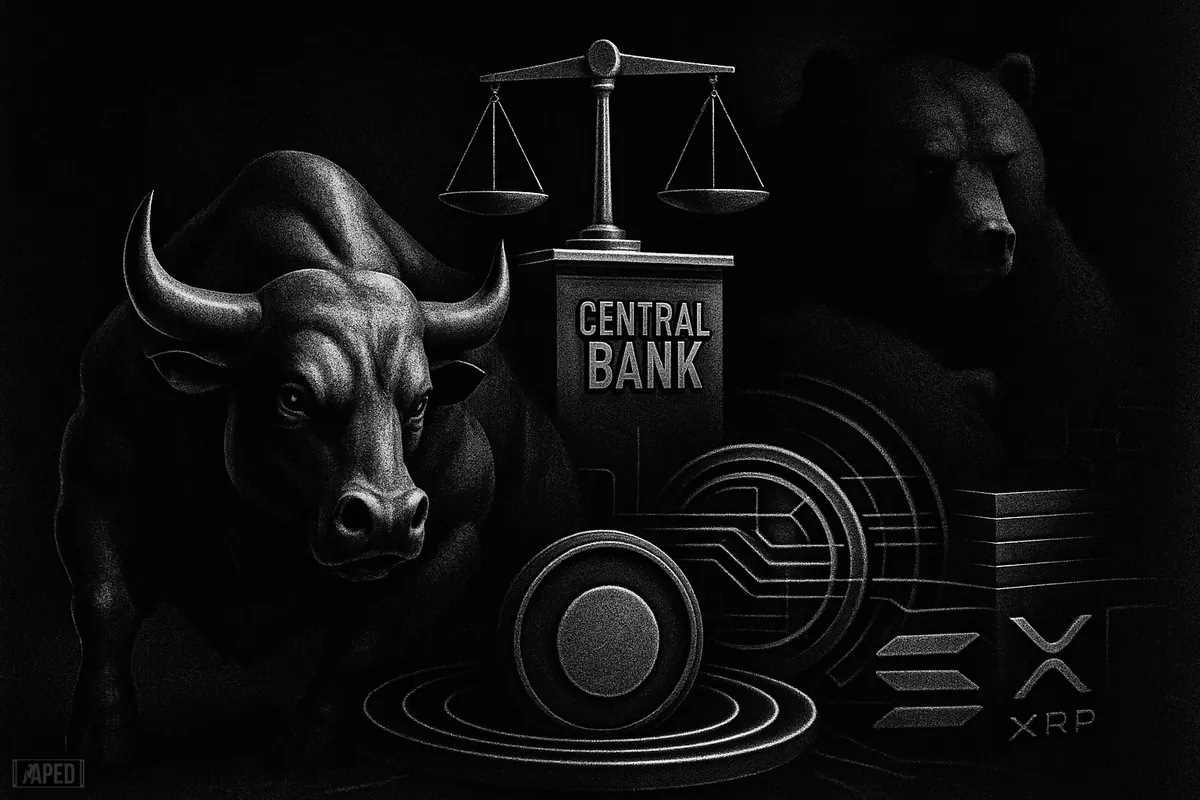
Markets spent May 16 doing what they do best around central bank days: pretending to be forward-looking while reacting to every nuance in real time. The broad setup was fairly clear by early morning UTC. The Fed held rates steady, policymakers split on what comes next, Bitcoin$80,477.01 was already struggling under nearby resistance, and by the evening the mood had tilted toward caution. Still, the day was not just about macro nerves. Stablecoin payments kept stealing the practical-use spotlight, first through Ripple's Ripple USD$1.00 activity on XRP$1.518Ledger and later through Meta's quiet USD Coin$1.0011 payout rollout for creators.
Enjoy articles without ads?
Register for free and get unlimited access to all articles.
Fed holds, but the split mattered more than the pause
The day's main macro event landed at 4:01 AM UTC, when the Federal Reserve kept rates unchanged at 3.50 percent to 3.75 percent. On paper, that was the least surprising outcome available. The more relevant detail was the FOMC split. One official favored a cut, while others pushed back against any premature easing signal. That left markets with the familiar gift basket of ambiguity: no hike, no cut, and just enough disagreement to keep everyone glued to the next inflation print. [1]
For crypto, the message was mixed rather than outright bullish. A hold removes immediate tightening pressure, but a divided committee complicates the timeline for easier financial conditions. Risk assets generally prefer clean narratives, and this was not one. The split suggested policy direction is still contested, which tends to keep volatility alive across Bitcoin, majors, and the higher-beta end of the altcoin complex.
By 6:01 PM UTC, the market framing had turned more defensive. Bitcoin$80,477.01 and altcoins were flagged as vulnerable to a pullback tied to FOMC risk, with BTC unable to reclaim the $79,000 area and momentum fading. That matters because the day before, Bitcoin had already slipped below $76,000 in broader weak price action. So this was less a sudden breakdown than a continuation of a fragile setup.
The key progression was chronological and fairly boring in the way important things often are. First came the Fed pause with an unhelpfully split committee. Then came the realization that a rate hold does not automatically revive risk appetite when traders are still uncertain about the next move. By the evening, the technical picture reflected that hesitation. Bitcoin's failure under $79,000 left the market exposed to another leg lower if macro data or positioning worsens. Altcoins, as usual, looked even less sturdy.
At 1:31 PM UTC, Ripple's Ripple USD$1.00 offered one of the day's cleaner utility datapoints. The stablecoin moved $59 million on XRP Ledger this week for a reported cost of just $0.000188. For once, a payments headline came with a number specific enough to survive contact with skepticism. [2]
That figure supports Ripple's long-running claim that blockchain-based settlement can handle high-value transfers at minimal cost. It also reinforces XRP Ledger's pitch as a payments rail rather than a venue that survives on narrative alone. Low fees are not a unique feature in crypto, of course, and "cheap" does not equal "adopted at scale." Still, moving tens of millions for a fraction of a cent is a strong demonstration, especially on a day when real utility looked more convincing than speculative momentum.
The RLUSD transfer metric landed in a market already leaning toward practical stablecoin stories. Yesterday's flow had included Visa expanding stablecoin rails and tokenized finance drawing fresh capital. Today's Ripple data fit neatly into that theme: infrastructure, settlement, and payment economics are attracting more attention than meme-fueled risk. Not because the market has become disciplined overnight, obviously, but because measurable usage is easier to defend when price action is shaky.
Late in the day, at 10:31 PM UTC, Meta rolled out USDC payouts for select creators in Colombia and the Philippines. The program uses Solana$76.56 and Bifrost Bridged MATIC (Bifrost)$0.112348 for cross-border payments. The scale appears limited for now, but the significance is hard to miss. A major tech platform is testing stablecoins for a real payout function, not a conference panel, not a pilot wrapped in ten layers of branding theater. [3]
The country selection also makes practical sense. Cross-border creator payouts often come with delays, high fees, and banking friction. Stablecoins can reduce all three, especially in corridors where dollar access and remittance efficiency matter. Using Solana and Polygon suggests Meta is optimizing for throughput and low costs rather than ideological alignment with any one chain camp.
Meta's move strengthens a pattern already visible across the week: stablecoins are becoming product features inside larger platforms, not just crypto-native trading instruments. That distinction matters. It shifts the story from "people in crypto use stablecoins" to "internet companies are starting to use stablecoins because they solve payment problems." There is still execution risk, jurisdictional complexity, and the usual possibility that pilots stay pilots. But as a signal, it is meaningful.
Research and AI
A pre-1930 AI test probed reasoning under uncertainty
One non-market item stood out at 9:01 AM UTC. A study tested a pre-1930 AI on Hitler, stocks, and forecasting to examine whether language models genuinely reason under uncertainty or simply reconstruct patterns from memorized historical data. It is not directly a crypto market driver, but it touches a theme that keeps surfacing across trading, research, and automated decision-making.
The study's relevance to digital assets is straightforward. Crypto remains one of the most AI-saturated sectors for market commentary, signal generation, and product hype. Any work that questions whether models actually reason, as opposed to remixing known patterns, is worth watching. Especially in a market where "AI-powered" is often used with the same precision as "community-led," which is to say, not much.
Context from the previous day
May 15 had already set the stage for today's flow. Visa expanded stablecoin rails, tokenized finance continued attracting capital, and Bitcoin slipped below $76,000. That combination mattered because it split the market narrative in two. On one side, infrastructure and tokenized finance kept advancing. On the other, BTC price action stayed soft. May 16 largely extended that divide rather than resolving it.
That is probably the cleanest summary of the current tape. Payments and settlement stories are accumulating evidence. Macro-sensitive price action remains unconvinced. Crypto can have genuine utility progress while traders still de-risk around central bank uncertainty. The market is complex like that, or indecisive if you prefer plainer language.
Key Takeaways
Today's biggest lesson was that macro still sets the trading tone, but stablecoins keep winning the adoption headlines. The Fed's rate hold did not provide enough clarity to revive broad risk appetite, especially with internal FOMC disagreement muddying the path ahead. Bitcoin's failure to break above $79,000 kept downside risk in play, and altcoins looked vulnerable by the close.
At the same time, the strongest concrete developments came from payment rails. RLUSD showed that large-value settlement on XRP Ledger can happen at negligible cost, and Meta's USDC payout rollout offered a more mainstream proof point for cross-border stablecoin utility. If this trend continues, the market may keep separating into two tracks: soft speculative sentiment, but steadily improving transactional adoption. [4]
The practical thing to watch next is whether stablecoin usage metrics keep rising even if BTC remains range-bound or weak. If they do, that would suggest the sector's utility layer is building independent momentum. If not, then today's adoption headlines risk becoming another round of "promising pilots" that everyone definitely predicted would change everything immediately.
Your reviews help us improve the quality of both current and future articles. All reviews are public and visible to other readers. We use both ratings and comments to improve future articles and to revise any articles that do not meet our standards.
 See more like this on Google