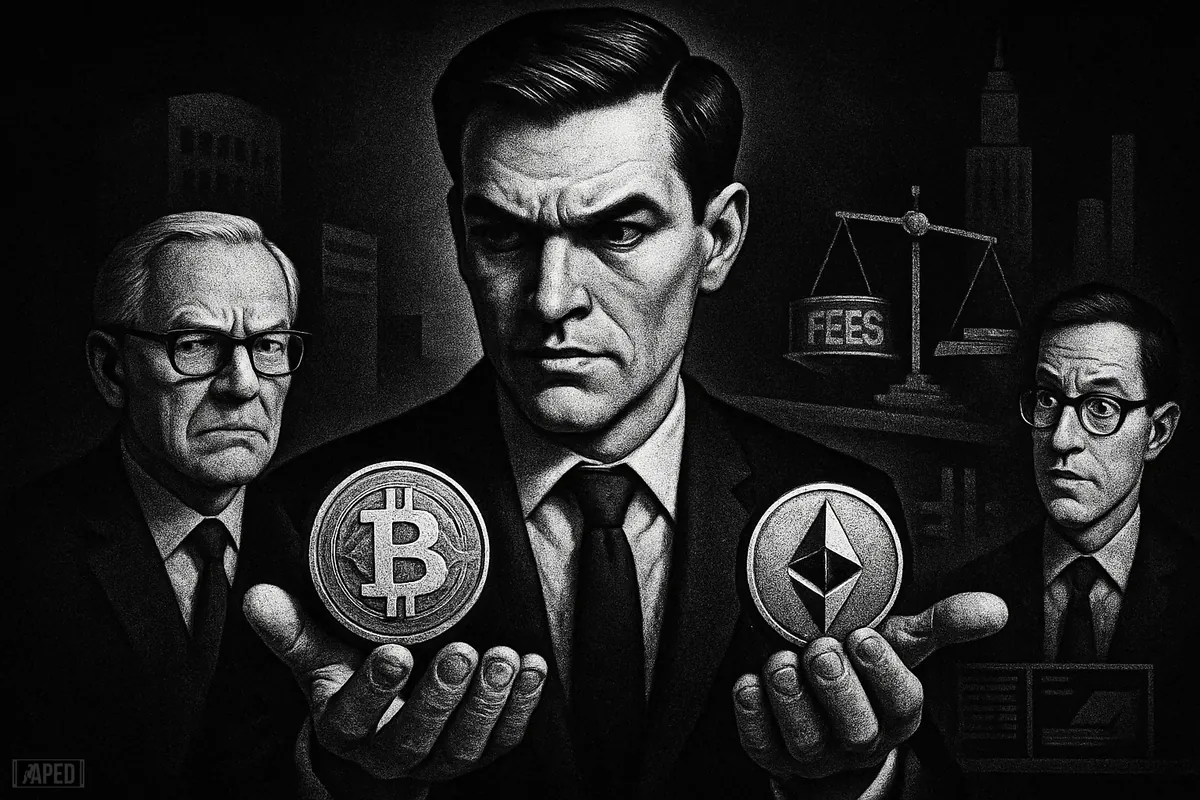
Charles Schwab is finally making its direct crypto move, but the trade-off is obvious: convenience versus cost. The $12 trillion brokerage is rolling out spotBitcoin$80,509.99 and Ethereum$2,341.88 trading through Schwab Crypto in the coming weeks, aiming squarely at retail investors who want crypto next to their stocks and ETFs. [1] The problem is the headline fee, 75 basis points per trade, which immediately puts the product under pressure against both crypto-native exchanges and low-cost spot Bitcoin ETFs. [2]
That fee is the whole story for now. If Schwab wants to win flows beyond curious first-time buyers, it needs investors to pay up for trust, simplicity, and account integration. Otherwise, the pitch starts to look expensive fast.
Enjoy articles without ads?
Register for free and get unlimited access to all articles.
Schwab's crypto launch is built for convenience
Schwab Crypto will launch with direct spot access to BTC and ETH, with more assets expected later. The setup is straightforward: clients can hold crypto alongside traditional investments inside the same Schwab ecosystem. For mainstream investors, that matters. One dashboard, one brand, one support stack, fewer operational headaches. [3]
Joe Vietri, Schwab's head of digital assets, framed the rollout as a portfoliodiversification tool for retail users who want exposure with more confidence. That is a familiar institutional pitch, and it lands better in 2026 than it would have a few years ago. Spot ETFs normalized crypto access for advisors and self-directed investors, and now brokerages want a bigger slice of that demand. [4]
Schwab is not alone here. Morgan Stanley, Goldman Sachs, NYSE-linked products, and other large financial players have all been expanding crypto offerings this year. The adoption wave is no longer about proving whether institutions will enter. They already have. The real fight now is over packaging, fees, and who owns the customer relationship.
The fee problem is hard to ignore
Bloomberg ETF analyst Eric Balchunas called Schwab's offer a "tough sell" from a cost perspective, and that feels about right. Schwab's 0.75% trading fee is roughly 7.5 times Binance's standard 0.1% spot fee. That is not a small gap, and cost-sensitive users will notice immediately. [2]
The more uncomfortable comparison is with spot Bitcoin ETFs. Balchunas pointed out that ETFs can often be bought for around 2 basis points at the transaction level, though investors still pay annual expense ratios to hold them. His core argument is practical: for someone making a single BTC purchase and holding for five years or more, buying direct can eventually be cheaper. For most other use cases, especially repeat buying, ETFs still look like the cleaner deal. [5]
That matters because the audience Schwab wants is probably not made up of hardcore self-custody Bitcoin maxis. It is more likely conservative retail and mass affluent clients who care about ease, familiar interfaces, and risk controls. Those same investors also tend to care about fees, especially when lower-cost wrappers already exist.
Why Schwab may still find buyers
High fees do not automatically kill a product if the buyer values frictionless access. Schwab has a huge embedded customer base, strong trust with older retail investors, and a platform that already houses retirement accounts, stock portfolios, and cash management tools. For a client who would never touch Binance and does not want to think about wallets, private keys, or exchange risk, Schwab's pricing may be annoying but tolerable.
That is the bull case. Newbies often pay a premium for perceived safety. Schwab may be betting that its users are not comparison shopping down to the last basis point, at least not initially.
Still, there is a ceiling to that logic. Spot ETFs already solved much of the "safe and familiar" problem, and they did it with lower carrying costs for many investors. Schwab is not just competing against offshore exchanges. It is competing against regulated products already sitting inside brokerage accounts.
The launch also comes during another period of constructive institutional flows. Spot Bitcoin ETFs logged $26 million in daily net inflows on Thursday, their third straight day of inflows, according to SoSoValue data cited in the source material. Bitcoin was trading above $75,000 at the time, which gives Schwab favorable optics. Launching a crypto product while BTC is firm and fund flows are positive is a much easier sell than debuting into a drawdown. [6]
But market tailwinds can hide weak product economics only for so long. If BTC keeps sending, some users will not care about paying 75 bps. If the market cools, fee sensitivity usually comes back fast.
Schwab's crypto push is credible, but the pricing leaves an opening. The platform makes sense for investors who want direct BTC and ETH exposure inside a familiar brokerage environment and are willing to pay for convenience. Everyone else has cheaper options already.
The watchlist is simple: user adoption after launch, any fee cuts, and whether Schwab expands beyond Bitcoin$80,509.99 and Ethereum$2,341.88 fast enough to keep attention. Nice brand, clean wrapper, expensive ticket. That is the setup.
Your reviews help us improve the quality of both current and future articles. All reviews are public and visible to other readers. We use both ratings and comments to improve future articles and to revise any articles that do not meet our standards.
 See more like this on Google