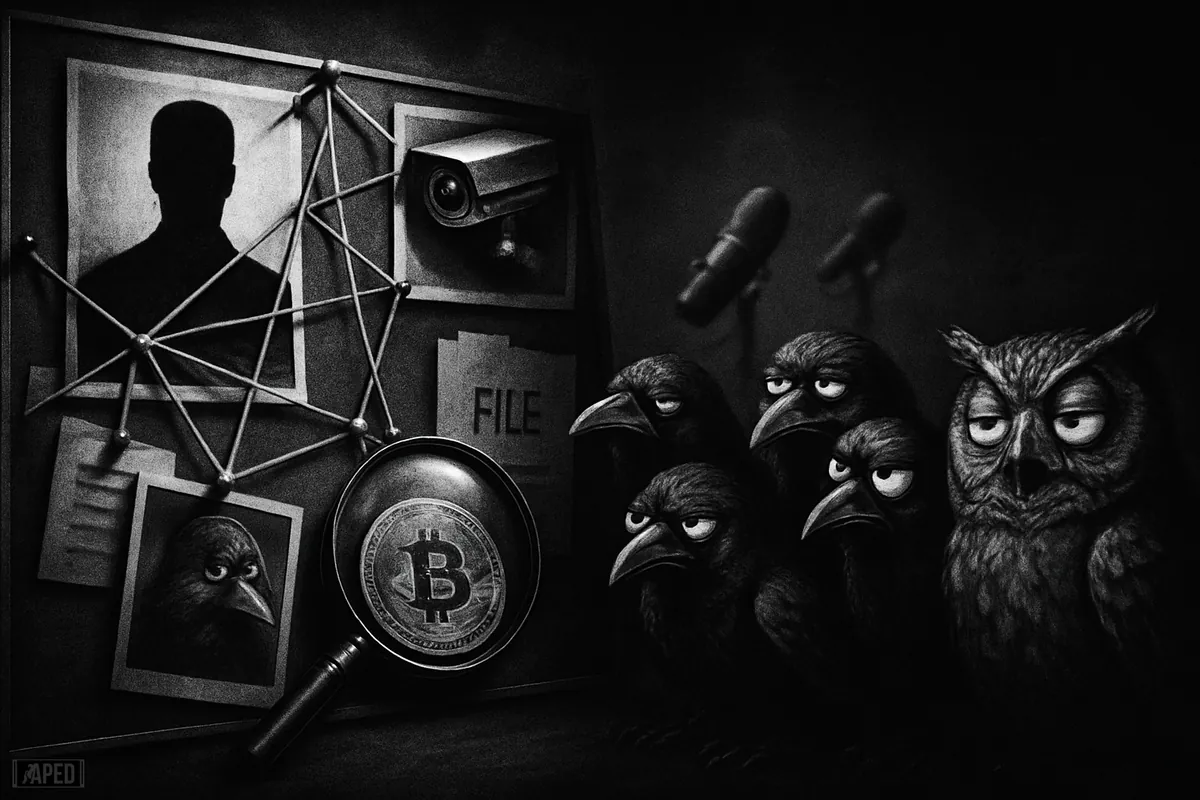
A fresh round of Satoshi cosplay hit crypto timelines this month, except this time the culprit was not a suit claiming to be Nakamoto. It was Professor Jiang, whose viral podcast appearance tried to game-theory Bitcoin$80,683.53 into a CIA project, and the market's reaction was basically a collective eye roll. [1]
The theory spread after Jiang appeared on the Jack Neel Podcast and argued that if you ask who could build Bitcoin, who benefits from it, and why the creator stayed anonymous, you land on the American deep state, specifically the CIA. He framed Bitcoin$80,683.53 as a possible surveillance system and even floated the idea that it could function as covert financial plumbing for off-the-books state activity. [2]
Enjoy articles without ads?
Register for free and get unlimited access to all articles.
What Jiang actually argued
Jiang's case rests on three pillars. First, that only a highly capable institution could have designed Bitcoin in 2008. Second, that intelligence agencies would benefit from a transparent ledger. Third, that anonymity around Satoshi Nakamoto would be necessary if the system had state origins, because open government branding would kill user trust before the network got off the ground.
That framing is built to sound tidy. Bitcoin is technically sophisticated, state agencies have deep research budgets, and public blockchains do make transaction histories visible. On paper, it is the sort of argument that can go viral fast, especially outside the bitcoinerbubble where mystery around Satoshi still carries a bit of cinematic glow. [3]
The backlash was not really about defending a sacred origin myth. It was about Jiang appearing to miss some very basic features of how Bitcoin$80,683.53 works.
Critics zeroed in on his comments about infrastructure and control, arguing that his line of questioning treated Bitcoin like a centrally hosted system rather than a distributed network. That matters because the entire design of Bitcoin is to avoid reliance on a single server, operator, or trusted institution. Ask where "the server" is and you have, unfortunately, told on yourself. [4]
Several commentators across X and crypto media mocked the claim as a category error. The strongest rebuttal was not that intelligence agencies are saints, clearly not, but that Bitcoin's architecture is open source, publicly auditable, and maintained by a messy global set of developers, node operators, miners, exchanges, and users. If this was a covert state product, it has been a spectacularly inconvenient one.
The surveillance claim runs into an obvious problem
Bitcoin is transparent, yes. It is also pseudonymous, unevenly traceable, and not especially elegant if your goal is secret state finance. Law enforcement and blockchain analytics firms can do a lot with on-chain data, but that is not the same as saying Bitcoin was built for perfect surveillance from day one.
Plenty of activity migrates through mixers, peer-to-peer transfers, cross-chain routes, privacy layers, and exchange accounts subject to varying compliance regimes. A government wanting seamless clandestine payment rails has easier tools available than releasing open-source money to the internet and hoping everyone adopts it.
The deeper issue for the CIA theory is that Bitcoin's codebase and development history have been pored over for years by independent researchers. That scrutiny has not produced evidence of a hidden administrative backdoor or a privileged control layer reserved for Langley. For all its mythology, Bitcoin behaves more like a protocol launched into the wild than a managed intelligence platform. [5]
That does not prove a state actor could not have contributed ideas or talent somewhere in the chain of cryptographic history. The internet itself grew out of state-funded research, and plenty of foundational technologies do. But that is a much weaker claim than saying the CIA created Bitcoin as a deliberate operation.
Why the theory still travels
Satoshi's identity remains unresolved, and unresolved stories attract conspiracy theories like memecoins attract weekend leverage. Over the years, candidates have ranged from cypherpunks and academic cryptographers to intelligence agencies and corporate labs. Each theory says as much about the moment pushing it as it does about Bitcoin itself.
Jiang's version landed because it taps into a broader suspicion now common across both crypto and mainstream politics: if a system becomes globally important, people assume a hidden hand must be behind it. Sometimes that instinct is healthy. Often it is just narrative overfitting.
Markets barely flinched, which says plenty
The episode generated social traction, not market structure. Bitcoin's price action around the debate did not show any meaningful repricing tied to Jiang's comments, and there was no notable on-chain dislocation, exchange flow anomaly, or derivatives stress event connected to the theory itself.
That is worth noting because crypto does occasionally trade on vibes, especially when a viral claim brushes against regulation, security, or existential protocol risk. This one did not. Traders treated it as content, not catalyst.
The data that would matter, if this became more than content
If some origin theory genuinely started altering sentiment, the first places to watch would be perpetual funding, open interest, spot ETF flows, and whale transfers to exchanges. A sharp rise in short bias, heavy long liquidations, or sudden net inflows to trading venues would suggest the market saw headline risk.
None of that appears to have emerged from Jiang's claim. For now, the only thing meaningfully pumped was discourse.
The real lesson from the backlash
Crypto's response shows that even a community famous for entertaining wild theories still expects technical coherence. You can speculate about Satoshi all day. You just cannot do it while sounding fuzzy on the difference between centralised infrastructure and a distributed ledger.
There is also a quieter point here. Bitcoin's origin story matters culturally, but the network's present-day legitimacy does not depend on solving it. The chain settles blocks whether Satoshi was one person, a group, or someone with a government badge. That is both the beauty and the irritation of open protocols, they outgrow their creators.
What to watch next
Whether Jiang responds to the criticism with a more detailed technical case, rather than broad game theory language
Whether the podcast clip keeps circulating beyond crypto-native audiences
Any renewed debate around Satoshi theories from academics, media figures, or policymakers
Market internals, especially funding, open interest, and exchange flows, in case a fringe narrative unexpectedly turns into headline risk
The usual caveat: origin-story chatter is mostly vibes unless it comes with evidence, and evidence remains in very short supply
Your reviews help us improve the quality of both current and future articles. All reviews are public and visible to other readers. We use both ratings and comments to improve future articles and to revise any articles that do not meet our standards.
 See more like this on Google