Background and history
From a corporate-profile perspective, PitchBook characterizes Etherscan as a private, venture capital-backed company in financial software. PitchBook lists Etherscan as founded in 2015, headquartered in Kuala Lumpur, Malaysia, with 70 employees. [3]
Key features and services
Transaction and block inspection
Address, token, and NFT visibility
Smart contract transparency and interaction
A key differentiator of Ethereum explorers is how they handle smart contracts. MoonPay highlights browsing and inspection of contracts, while Coinbase explicitly notes that users can interact directly with smart contracts via Etherscan to process transactions and observe gas fees. This is a powerful feature, but it is also one that increases the need for user caution. Contract interaction tools assume the user understands what they are signing and can correctly interpret parameters and permissions. [4] [2]
Gas and network conditions
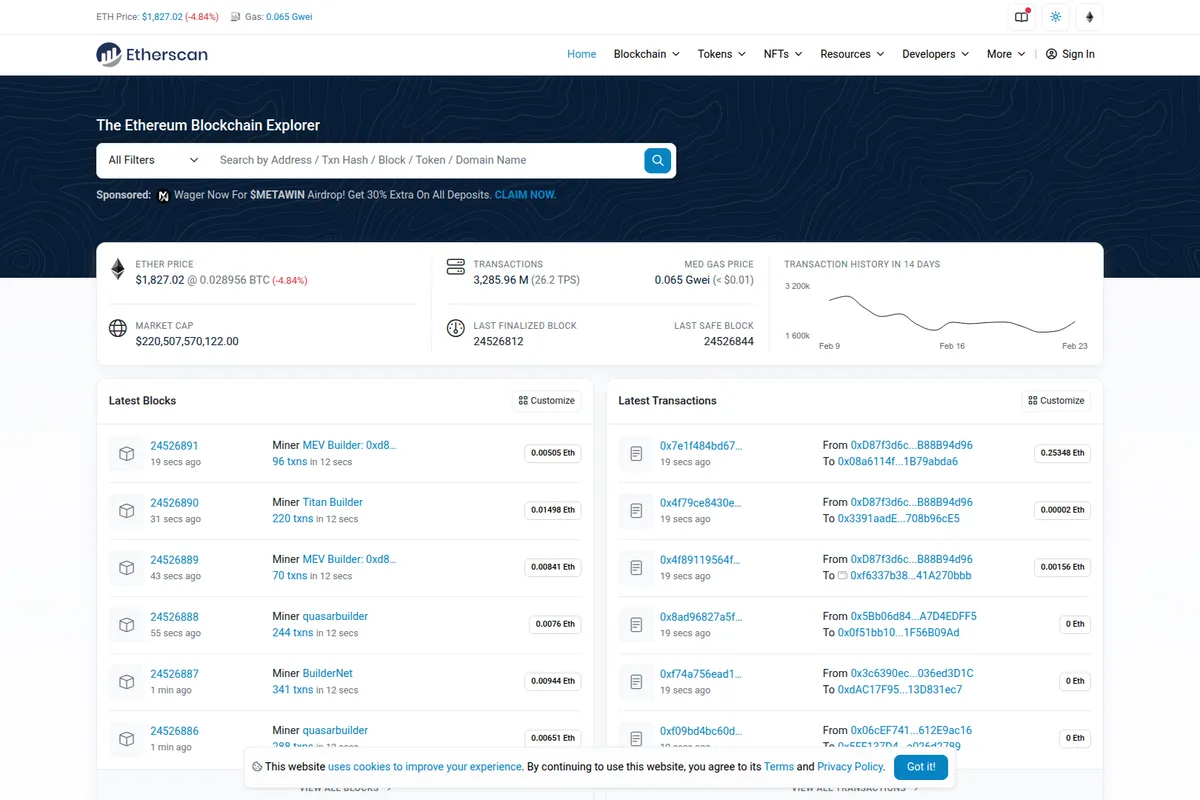
Both Coinbase and MoonPay call out gas as a key concept surfaced by Etherscan. MoonPay describes gas as the amount of ETH used to pay for a transaction, and Etherscan itself prominently displays gas-related information in its interface, including a median gas price on the homepage. In practice, this helps users decide whether to wait for cheaper network conditions or whether a transaction’s fee seems unexpectedly high. [1] [2]
Accounts, alerts, and multi-network navigation
Security and trust
Reputation signals and review caveats (Trustpilot)
A major reputational datapoint in the provided research is Trustpilot’s etherscan.io listing. Trustpilot displays a TrustScore of 1.7 with 26 reviews and labels the profile as unclaimed. It also includes a cautionary note that “This company may be associated with high-risk investments.” [5]
Practical safety framing
Given what Etherscan is and is not, a practical way to think about safety is:
- Etherscan can help you confirm facts, such as where a transaction went, whether a contract call succeeded, and what fees were paid. [4]
- Etherscan cannot reverse a transaction, unlock funds, or “release” assets. Those outcomes are controlled by smart contracts, custodial platforms, or the user’s wallet keys.
- Because explorers are frequently used during high-stress moments (missing funds, stuck bridge transfers), users are especially vulnerable to impersonation emails and “recovery” pitches. The Trustpilot excerpt even includes a warning-style review comment about emails from a different domain, which underscores the need to verify domains and links carefully. [5]
User experience
There are also UX tradeoffs. The same completeness that makes Etherscan useful can feel overwhelming for beginners. Third-party guides emphasize that it was created to make hard-to-read blockchain information digestible, especially for newcomers, which implies the baseline is still complex. [2]
Another practical consideration is monetization. The captured homepage includes sponsored advertising placements, which is common for free infrastructure sites but can distract users and, in worst cases, create confusion if users do not distinguish ads from navigational elements. [1]
Pricing and fees
For typical users, Etherscan’s core functionality is accessed directly from the website without an obvious per-lookup fee. The platform appears to be supported, at least in part, by advertising and sponsored placements shown in the UI. [1]
It is important to separate Etherscan’s site usage from blockchain costs. When users interact with contracts or submit transactions, the fees are Ethereum network gas fees, not “Etherscan fees.” Coinbase’s description of viewing gas used and using Etherscan to interact with contracts reinforces that cost visibility is part of the explorer experience, but the payment is to the network via the user’s wallet transaction. [4]
Comparison with alternatives
Etherscan’s competitive set depends on what you actually need: a like-for-like Ethereum explorer, a multichain search engine, a self-hosted/open-source explorer, or a business platform for APIs, monitoring, and compliance.
Like-for-like explorer alternatives
Alchemy’s “Etherscan Alternatives” list (captured as 16 results) includes several direct explorer substitutes:
- Blockscout, positioned for inspecting transactions on EVM-compatible chains.
- Blockchair, described as a blockchain search and analytics engine.
- Ethplorer, described as an Ethereum blockchain explorer.
- Otterscan, described as an open-source Ethereum block explorer.
- Chainlens, described as a modern, user-friendly, fast explorer for EVM networks.
These options can be attractive if you want different UI choices, broader EVM coverage, or open-source deployment options (in Otterscan’s case). [6]
MoonPay also lists alternatives such as Blockscout, Etherchain, Ethplorer, Blockchair, and BeaconScan, reinforcing that Etherscan is widely used but not the only viable explorer. [2]
Developer, infrastructure, and compliance “alternatives”
Slashdot’s “Alternatives to Etherscan” page frames replacements more broadly, including products that overlap with how teams use Etherscan data rather than the explorer UI itself.
Examples in the captured list include:
- Blockdaemon, positioned around staking, nodes, APIs, DeFi, and MPC wallets, with claims including support for over 400 organizations and more than $110B in managed digital assets since 2017.
- Tatum, listed with pricing shown as $9 per month, positioned as a unified development platform with a JavaScript SDK and REST APIs supporting 40+ digital assets and 40+ blockchain protocols.
- Venly, listed with pricing shown as $0 per month, positioned as a wallet and NFT marketplace toolkit provider.
- Crystal Blockchain, positioned as an all-in-one blockchain analytics tool for AML compliance and real-time transaction monitoring across thousands of cryptocurrencies.
These are not direct Etherscan UI substitutes, but they can be practical alternatives for organizations that need programmatic access, monitoring workflows, or compliance tooling beyond a public explorer. [7]
Final verdict
Etherscan remains a foundational utility for Ethereum: it turns a public ledger into searchable, near real-time pages for transactions, wallets, tokens, NFTs, and smart contracts, and it helps users understand gas, execution details, and contract activity without running their own node. External explainers describe it as the most popular Ethereum block explorer and repeatedly compare it to a search engine for on-chain data, which captures its core value. [2]
From a company profile lens, PitchBook presents Etherscan as an established, private, venture-backed firm founded in 2015, headquartered in Kuala Lumpur, with disclosed fundraising totaling $1.04M and documented corporate activity including the Solscan acquisition in 2024. [3]
Overall, Etherscan is best rated as a high-quality Ethereum transparency and verification layer with strong day-to-day utility, particularly for transaction tracking and contract inspection, but with reputational noise in consumer-review contexts and typical explorer-adjacent phishing and ad-related risks that users should actively mitigate by verifying domains and links. [1]