Background and history
It is also worth calling out a common search-result confusion: a “ArtSpace AI Review + Tutorial 2026” video covers an AI image-generation product at artspace.ai, not Dropspace at dropspace.art. If you are evaluating Dropspace, you should ignore that review because it addresses a different platform with different risks and features. [4]
Key features and services
Dropspace’s value proposition is best understood as two products in one.
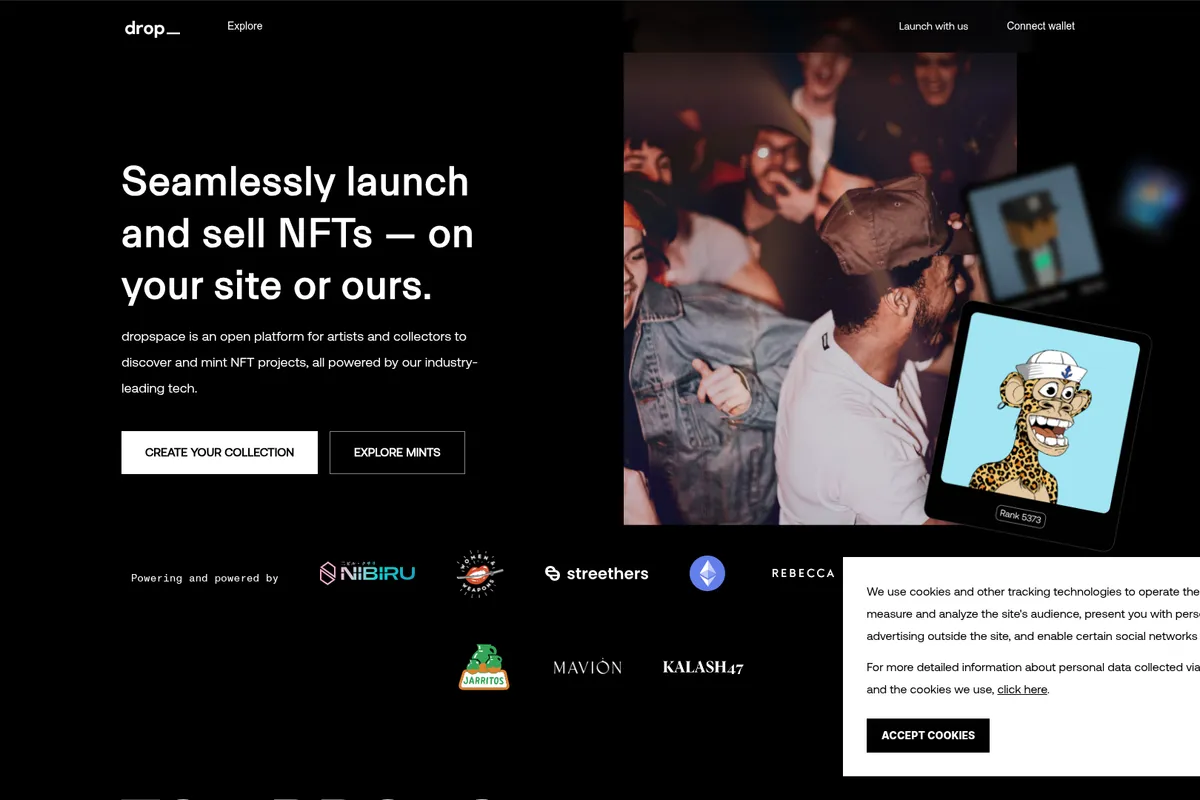
First, it markets itself as a user-facing environment where collectors can discover and mint live projects. The site includes an “Explore” entry point and a wallet-connection flow, which is typical for NFT minting experiences. [1]
Second, it positions itself as creator infrastructure for launching an NFT collection with minimal engineering overhead. In Alchemy’s Dapp Store, Dropspace is listed under “NFT Minting Tools” and described as a “full-service minting platform” that works with creators to handle technical tasks, so the creator can primarily provide the artwork. [5]
No-code and “full-service” launch support
The most concrete feature list in the provided sources comes from Alchemy’s directory listing. That page explicitly states Dropspace can provide:
- Smart contracts
- A unique dedicated web page on Dropspace
- A Web3 website
- IPFS pinning
- Image layering or generation
- OpenSea setup and reveal
- A minting window for the community
Selling NFTs “on your site or ours”
A Vara ecosystem listing makes this framing even more explicit, describing Dropspace as a toolkit that simplifies minting, metadata, and integrating NFT sales into websites. The listing uses a strong analogy: “Imagine it not like a launchpad but like a Stripe-like tool for easy NFT minting. You embed the widget on your website and voila, you sell your NFT.” Even if this is marketing language, it is a helpful mental model for how Dropspace wants to be used, as an embedded minting widget or checkout-like component rather than purely a marketplace. [6]
Multi-ecosystem positioning (Ethereum, Polygon, and Vara)
Dropspace’s chain support is somewhat ambiguous in the provided sources, but several references are consistent.
- Alchemy’s listing shows Ethereum and Polygon logos. [5]
- The Dropspace homepage includes partner or ecosystem logos that link to ethereum.org and polygon.technology. [1]
- The Vara ecosystem page describes Dropspace as “Built on Vara” and calls it “Easy no-code NFT minting on Vara.” [6]
Documentation, legal pages, and external links
Dropspace links out to a Walkthrough and FAQ hosted on Notion, along with Notion-hosted Terms of Service and Privacy Policy pages. Hosting documentation and policies on Notion is common among smaller crypto teams because it is fast to update, but it also means users should verify they are reading the latest version and should keep copies for reference when participating in paid mints. [1]
Security and trust
What third-party risk validators say
Two automated validators provide the bulk of publicly available “review-like” signals in the supplied research.
Scam-Detector gives dropspace.art a 75.9/100 reputation score, labels it “Standard. Valid. Common.,” and says the score indicates “low risk” while still “warranting a little caution.” It also states the domain was not detected by blacklist engines in its scan. [3]
Taken together, these are not endorsements of Dropspace’s product quality, but they do suggest the domain is not broadly flagged for common scam patterns at the time those tools checked it.
HTTPS and basic site security
Both validators report valid HTTPS for dropspace.art, which is a baseline requirement for encrypting traffic and protecting users from basic network interception. ScamAdviser describes the SSL as domain validated and issued by Let’s Encrypt, while Scam-Detector reports an SSL issuer of cPanel, Inc., which may reflect different detection times or infrastructure changes. Either way, HTTPS does not verify the organization’s identity, but it is still a necessary minimum for a wallet-connect site. [2] [3]
Ownership transparency and WHOIS privacy
Practical safety checks before you connect a wallet
- The exact mint URL and that it is on the official dropspace.art domain
- The chain you are minting on (Ethereum, Polygon, or another network)
- The contract address and whether it is verified on a block explorer
- The transaction details presented in your wallet before signing
- Whether the mint page clearly discloses total cost (mint price plus gas, plus any platform fees)
User experience
From the available first-party description, Dropspace leans into a straightforward Web3 UX: connect wallet, explore mints, or start a launch flow. That simplicity is aligned with its “no-code” positioning. [1]
For creators, the user experience promise is mostly about reducing complexity. Alchemy’s listing implies a concierge-like model where Dropspace “personally” works with a creator and handles technical tasks like smart contracts, IPFS pinning, and OpenSea setup. If accurate for current operations, this can be a meaningful differentiator compared to self-serve minting tools that leave creators to solve metadata hosting, reveal mechanics, and marketplace configuration on their own. [5]
There are also some UX trade-offs implied by the source set:
- Documentation and policies are linked via Notion rather than a dedicated docs portal, which can be perfectly functional but may feel less “productized” than competitors.
- Lower popularity signals in validator tools suggest there may be fewer community tutorials, independent reviews, and troubleshooting threads than with large platforms.
Pricing and fees
Pricing is one of the least clear aspects in the supplied research.
- a free tier on a specific chain or ecosystem,
- creators paying for “full-service” support while collectors simply pay mint price and gas,
- or a mix of free tooling plus paid add-ons.
However, because no concrete fee schedule, platform commission, or plan breakdown is included in the provided sources, users should treat pricing as unknown until confirmed in writing by Dropspace or in its Terms. [5] [6]
In practical terms, if you are comparing Dropspace with alternatives, you will want to ask three specific questions:
- What does Dropspace charge creators, if anything, and is it fixed, percentage-based, or service-based?
- Are there additional fees beyond the chain’s gas fees, such as platform fees on mint transactions?
- What costs are bundled, for example IPFS pinning, generative layering, or OpenSea setup?
Comparison with alternatives
Dropspace is best compared with two categories of platforms: NFT marketplaces and NFT minting infrastructure tools. The provided alternatives list focuses heavily on marketplaces, so the key is to understand the functional difference.
Dropspace vs OpenSea
Dropspace vs Magic Eden
Dropspace vs curated art platforms (Foundation and SuperRare)
Dropspace vs Rarible and other open marketplaces
Rarible is framed as a community-oriented, multi-chain marketplace with variable fees and creator controls such as configurable royalties. If your main goal is to mint and list directly into a marketplace environment with built-in buyers, open marketplaces can reduce the need to drive all of your own traffic. Dropspace’s differentiator is not marketplace liquidity, at least based on the supplied sources, but a launch workflow and embedded sales capability. [7] [5]
Not a direct alternative: print-on-demand “dropshipping” sites
Some search results mix “dropspace” queries with “dropshipping” for physical art prints. Print-on-demand services like Printful or Gooten address a completely different problem: manufacturing and shipping physical products without inventory. They are not substitutes for NFT minting infrastructure, though they can complement an artist’s monetization strategy. If your goal is NFT minting, these are not functional alternatives. [8]
Final verdict
Dropspace is best viewed as a creator-oriented NFT minting and launch platform, with an emphasis on no-code or full-service setup, dedicated mint pages, and the ability to sell NFTs either on Dropspace or embedded into a creator’s own website. Third-party listings describe a robust launch checklist, including smart contracts, IPFS pinning, generative layering, and OpenSea setup and reveal, which is a compelling bundle for teams that want to move fast without deep Web3 engineering resources. [5] [1]
If you are a creator, Dropspace may be worth considering when you want hands-on launch support or embedded minting on your own site. If you are a collector, it should be approached like any minting site: verify links, confirm chain and contract details, and only sign transactions you fully understand. Finally, because the provided sources show conflicting pricing descriptors, treat fees as an open question and confirm them directly before committing.