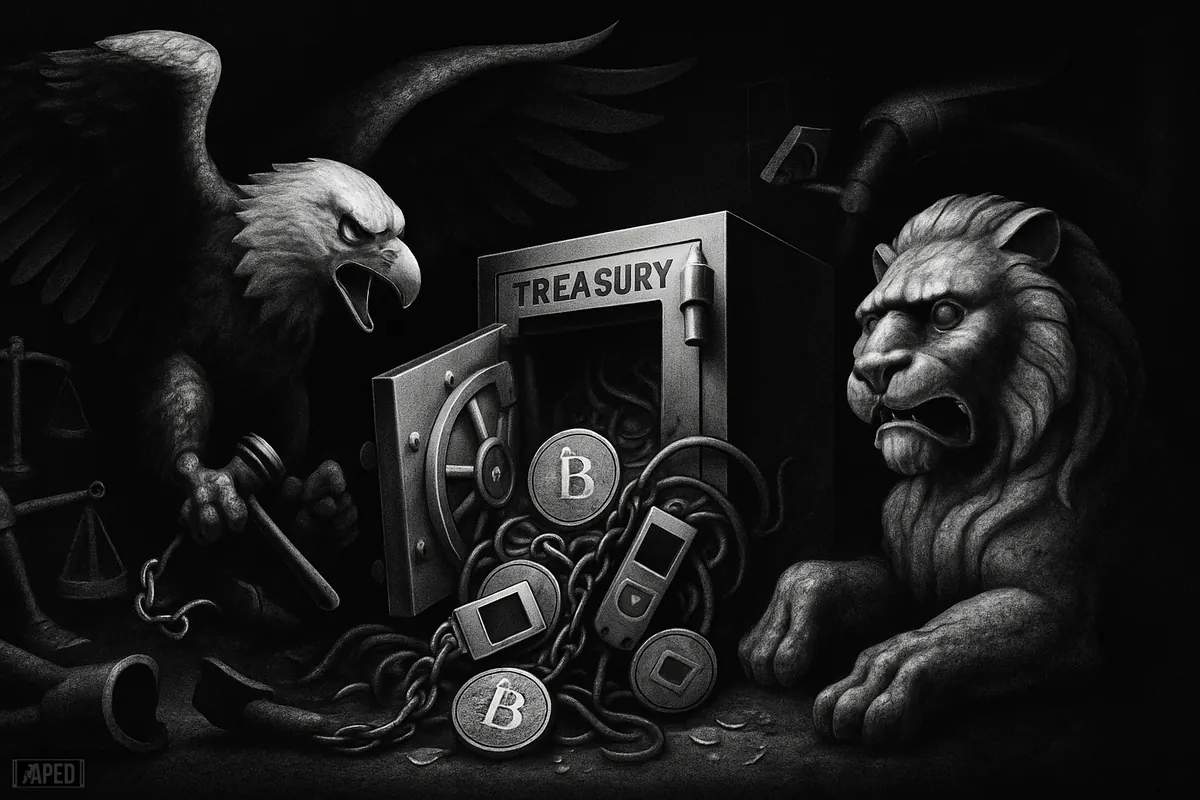
Washington has spent years saying crypto should not become a sanctions escape hatch. Iran, apparently, took that less as a warning and more as a workflow.
The latest U.S. Treasury action targets what officials describe as an Iran-linked Bitcoin$83,899.99network used to move value around sanctions walls, with reporting around the case pointing to a broader regime-connected crypto pipeline worth billions. The headline figure circulating in recent coverage is roughly $7.7 billion tied to an Iranian crypto ecosystem under scrutiny. Treasury's move is part of a wider enforcement push aimed at cutting off digital asset channels that allegedly support Tehran's financial operations, including fronts, exchange infrastructure, and wallet networks designed to blur the origin and destination of funds. [1][2]
Register for free and get unlimited access to all articles.
What Treasury is targeting
The core issue is not that Iran uses Bitcoin$83,899.99. Plenty of governments, companies, and retail traders use Bitcoin. Treasury is focused on networks allegedly linked to sanctioned actors and state-aligned financial activity, particularly channels used to bypass restrictions on cross-border payments.
That means wallet addresses, facilitators, brokers, and exchange touchpoints, not some magical "Bitcoin network" switch that can be flipped off. Sanctions enforcement in crypto usually works at the edges: identify addresses, map flows, designate counterparties, and make it expensive or legally risky for exchanges and service providers to touch those funds.
Recent reporting describes this effort as part of "Operation Economic Fury," a U.S. campaign aimed at revenue streams connected to the Iranian regime. The crypto angle matters because digital assets offer an alternative settlement rail when access to dollar banking is limited. Not frictionless, not invisible, not consequence-free, but useful enough that Treasury keeps coming back to it. [3][4]
Why Iran would use crypto in the first place
For a sanctioned economy, Bitcoin$83,899.99 solves a narrow but real problem: it lets value move without relying on correspondent banks that can be pressured by Washington. That does not make it a perfect sanctions shield. Public blockchains are transparent by design, which is awkward if your goal is not being noticed. Still, transparency is only useful when investigators can link wallets to real entities and then force intermediaries to comply.
The practical appeal
Iranian entities and affiliated networks have long faced restrictions on dollar clearing, trade finance, and international transfers. Crypto can offer:
settlement outside traditional banking rails
faster cross-border transfers
access to OTC brokers and offshore exchanges
a path to convert local proceeds into harder-to-censor digital assets
Bitcoin is especially relevant because of its liquidity and global market depth. If you need to move meaningful size, obscure altcoins are not exactly the institutional-grade answer, despite what their Telegram groups may believe. [5]
Bitcoin's ledger is public. Once investigators identify clusters of addresses, they can trace flows across wallets, mixers, and exchange deposits. That does not stop transfers from happening, but it narrows the exits. A sanctioned network can still move coins on-chain. Turning those coins into spendable fiat, stablecoins, or imported goods gets harder when exchanges, custodians, and counterparties are warned off.
That is why Treasury actions often look incremental. Freeze one cluster, identify the next set of intermediaries, repeat. It is less a final knockout than a financial strangulation strategy.
The scale of the network under scrutiny
The most cited figure in current coverage is $7.7 billion, attached to an Iran-linked crypto network reportedly tied to regime-connected activity. That number should be read carefully. It does not necessarily mean Treasury seized $7.7 billion, nor that every dollar flowing through those wallets was state revenue in the narrow legal sense. In sanctions reporting, "linked to" can include a broad web of affiliated entities, service providers, and transaction history. [6][7]
Another figure that has surfaced in related reporting is in the hundreds of millions of dollars frozen or blocked through prior enforcement actions. That gives a more concrete sense of what enforcement looks like in practice: not one giant confiscation, but repeated interventions that carve away at usable liquidity. [8]
Bitcoin, sanctions, and the cat-and-mouse problem
This is the part where crypto marketing usually says decentralization makes enforcement obsolete. Sure. In reality, sanctions enforcement has adapted by targeting chokepoints.
The U.S. playbook
Treasury and associated agencies generally rely on four levers:
Wallet designations: Publicly naming addresses linked to sanctioned actors.
Exchange pressure: Forcing centralized platforms to block, freeze, or report suspicious funds.
Chain analysis: Using forensic tools to cluster addresses and trace transaction paths.
Secondary deterrence: Warning foreign firms that servicing sanctioned entities can carry consequences.
This playbook does not "ban Bitcoin." It narrows the practical utility of Bitcoin for the sanctioned party. If coins can move but cannot be cashed out safely at scale, the system becomes less efficient.
Iran's likely response
Networks under pressure usually adapt by shifting wallets, using OTC desks, relying on intermediaries in permissive jurisdictions, or moving into stablecoins and privacy-enhancing techniques. That adaptation cycle is why this remains a cat-and-mouse game rather than a solved enforcement problem.
Bitcoin may be the headline, but investigators increasingly watch cross-chain movement and stablecoin conversion points too. If Tehran-linked operators decide BTC is too exposed, funds can migrate elsewhere. Treasury knows that, which is why enforcement has broadened beyond a single asset.
Market impact, probably smaller than the headline suggests
For crypto markets, these actions are usually more important as a compliance signal than as a price shock. Bitcoin trades in a global market measured in hundreds of billions of dollars in daily volume across spot and derivatives venues. Even a large sanctions case rarely moves BTC on its own unless it triggers broader regulatory fear.
The bigger effect lands on infrastructure providers. Exchanges, custodians, OTC brokers, and analytics firms get another reminder that sanctions screening is no longer a side function. It is core plumbing. Firms with weak compliance around high-risk jurisdictions are being handed a fairly blunt message.
There is also a political signal. Treasury wants to show that public blockchains are not exempt from financial surveillance and that sanctions can follow value onto new rails. Whether that fully deters state-linked actors is another matter. Deterrence in these cases is often partial by design: raise costs, reduce throughput, force operational mistakes.
Why It Matters
The Treasury action underscores a simple point that both crypto boosters and crypto critics often overstate in opposite directions. Bitcoin is neither a perfect sanctions loophole nor a useless tool for sanctioned actors. It is useful enough to be worth exploiting, and transparent enough to be worth policing.
For Iran, crypto offers a workaround with friction. For Treasury, blockchain offers evidence with delay. That tension is the story. The next thing to watch is not whether Bitcoin "wins" or sanctions "win," because real policy is less theatrical than that. Watch whether Treasury publishes more address clusters, whether exchanges tighten controls on Iran-linked flow patterns, and whether enforcement expands from Bitcoin into the Tether$0.999021 rails where a lot of real-world settlement now happens. Mildly impressive technology, meet extremely persistent bureaucracy.
Your reviews help us improve the quality of both current and future articles. All reviews are public and visible to other readers. We use both ratings and comments to improve future articles and to revise any articles that do not meet our standards.
 See more like this on Google