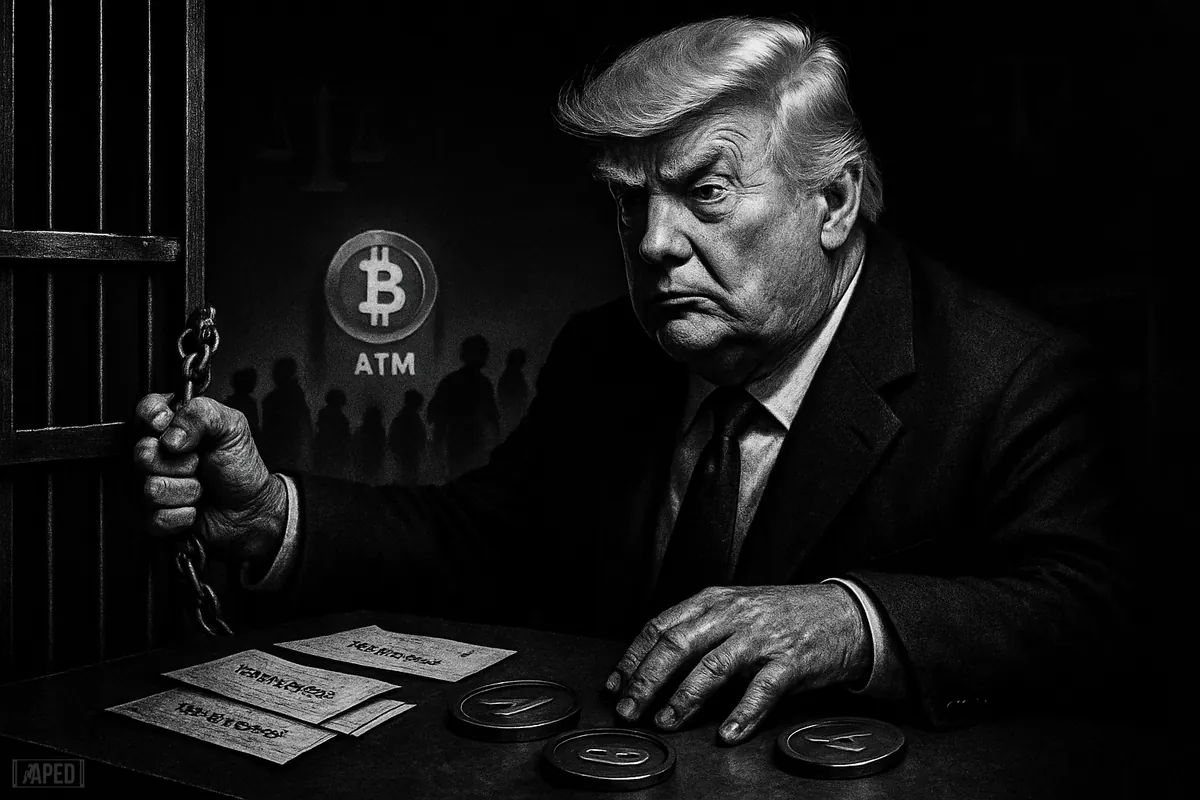
The trade here is not subtle: tighten the screws on cross border movement, and money routes adapt. President Donald Trump's immigration push could end up doing something Washington rarely intends cleanly, nudging more remittances and cash conversion activity into stablecoins and, at the rougher edge, Bitcoin$83,460.63 ATMs.
Enjoy articles without ads?
Register for free and get unlimited access to all articles.
Why an immigration order could matter for crypto rails
The basic mechanism is practical, not ideological. If migrants, mixed status households, or newly constrained workers face more friction using traditional banking or money transfer channels, dollar linked digital assets become more attractive. Stablecoins offer near instant settlement, global portability, and fewer gatekeepers than bank wires or mainstream remittance apps. [1]
That does not mean the White House is endorsing crypto as a workaround. Quite the opposite. But policy pressure often shifts demand toward financial tools that are cheaper, faster, harder to interrupt, or all three. Stablecoins already fit that bill for users moving small sums across borders, especially where recipients want dollars rather than local currency exposure.
Bitcoin ATMs sit in the same conversation for a less flattering reason. They are expensive and often clunky, but they remain one of the easiest cash to crypto on ramps for underbanked users, people without robust ID access, or anyone trying to move value quickly outside traditional retail banking. If formal channels become more restrictive, kiosk based conversion can pick up, even if fees are ugly.
The stablecoin angle is stronger than the Bitcoin ATM angle
Stablecoins are the cleaner beneficiary because the use case is obvious: remittance, savings, and settlement. A worker paid in cash can convert dollars into USD Coin$1.0011, Tether USD$0.1054, or another dollar token and send value to family in minutes. Recipients can cash out locally, hold the balance in dollars, or use it in peer to peer markets.
That route has been building for years, but tougher immigration enforcement could intensify it at the margin. Families dealing with documentation risk or account scrutiny may prefer rails that do not depend on a conventional bank relationship. For communities already using WhatsApp, informal brokers, and mobile wallets, stablecoins are not some futuristic leap. They are simply another payment layer.
The political backdrop also matters. Trump has been increasingly friendly to crypto, and 2025 has brought fresh federal momentum for stablecoin policy. The recently signed GENIUS Act gives the sector a clearer legal frame around issuance and oversight, which could make stablecoin infrastructure more available through regulated intermediaries over time. That is a strange split screen: one part of government tightens migration policy, another formalises the dollar token economy that can thrive under financial friction. [2][3]
Why dollar tokens benefit when trust in intermediaries drops
Stablecoins win when users need certainty on value and speed on transfer. Volatile assets like BTC can serve as a bridge asset, but they are less ideal for sending rent money home. No one wants to lose 4 percent on a market wobble between conversion and receipt. That is why the likely boost is to stablecoins first, Bitcoin second.
The numbers already show where the market's weight sits. Dollar stablecoins dominate on chain settlement volumes across major networks, with TRON$0.327, Ethereum$2,616.36, and Solana$76.56 functioning as key transfer rails. Tron in particular has become a major corridor for small and medium sized dollar transfers because fees are low and wallets are widely used in emerging markets. If immigration pressure increases informal remittance demand, Tron based stablecoin flows are a reasonable place to watch. [4]
This is also where crypto gets annoyingly real. A stablecoin transaction does not care whether the sender is moving $80 or $8 million. That neutrality is part of the appeal, and part of the regulatory headache. The same features that make stablecoins useful for households also make policymakers nervous about sanctions evasion, illicit finance, and tax leakage.
Bitcoin ATMs could see niche demand, but fees remain a problem
The ATM thesis is plausible, though narrower. Bitcoin and crypto kiosks are often used by people who want cash access without a full exchange setup. If more users seek alternatives to bank linked rails, some of that demand can spill into physical machines. Operators could see higher transaction counts in neighbourhoods with large remittance traffic or lower banking penetration.
Still, there are hard limits. Fees at Bitcoin ATMs can be punitive, sometimes well into double digits when spread and service charges are combined. That makes them a poor default option for routine remittances. They are more likely to serve as an emergency bridge than a primary payment rail.
Compliance is another drag. US based ATM operators have faced growing scrutiny around anti money laundering controls, scam activity, and customer verification. If policymakers start linking crypto kiosks to immigration workaround narratives, enforcement could tighten further. So yes, demand may rise, but so could the heat.
What this means for issuers, wallets, and payment apps
If this thesis plays out, the winners are not necessarily the most speculative crypto assets. The more direct beneficiaries are stablecoin issuers, self custody wallets, OTC agents, and payment apps that make dollar token transfers simple. Wallet UX, local cash out options, and low fee networks matter more here than token memes.
USDC, USDT, PayPal USD$0.999864, Ripple USD$1.00, and other regulated or semi regulated dollar products may all compete for this flow, but distribution is everything. The stablecoin with the best local merchant acceptance, exchange support, and cheapest transfer path usually wins, regardless of branding. That has been Tether's edge internationally for years, though new US policy clarity could help rivals push harder. [5]
There is also a second order effect. More everyday stablecoin use strengthens the case that dollar tokens are becoming shadow payment infrastructure for real world commerce, not just exchange collateral. That is bullish for networks and firms building around transfers, compliance tooling, and on chain foreign exchange.
The irony is fairly rich. A government can clamp down on movement of people while simultaneously making digital dollars more legitimate and more useful. If that produces a larger offshore and peer to peer stablecoin economy, the state has not killed financial mobility. It has just changed the rails.
That does not make the thesis cleanly bullish. More use driven by legal precarity is not the sort of adoption story the industry likes to put on conference slides. It also invites a tougher response from regulators, particularly around wallet surveillance, KYC standards, and unlicensed money transmission. Any spike in informal stablecoin usage could bring faster enforcement just as quickly as it brings growth.
What to watch next
Stablecoin transfer growth on Tron, Solana, and low cost Ethereum L2s
Changes in remittance corridor activity, especially US to Latin America
Bitcoin ATM transaction volumes in underbanked urban markets
New compliance actions against kiosk operators and OTC cash brokers
Whether regulated stablecoin issuers expand cash in and cash out partnerships
Any attempt by federal agencies to connect immigration enforcement with crypto monitoring
If Trump's immigration order raises friction in the traditional system, crypto will not absorb all of that displaced demand. But stablecoins do not need to capture all of it. They just need to be the fastest working alternative when the usual rails get slower, stricter, or shut.
Your reviews help us improve the quality of both current and future articles. All reviews are public and visible to other readers. We use both ratings and comments to improve future articles and to revise any articles that do not meet our standards.
 See more like this on Google