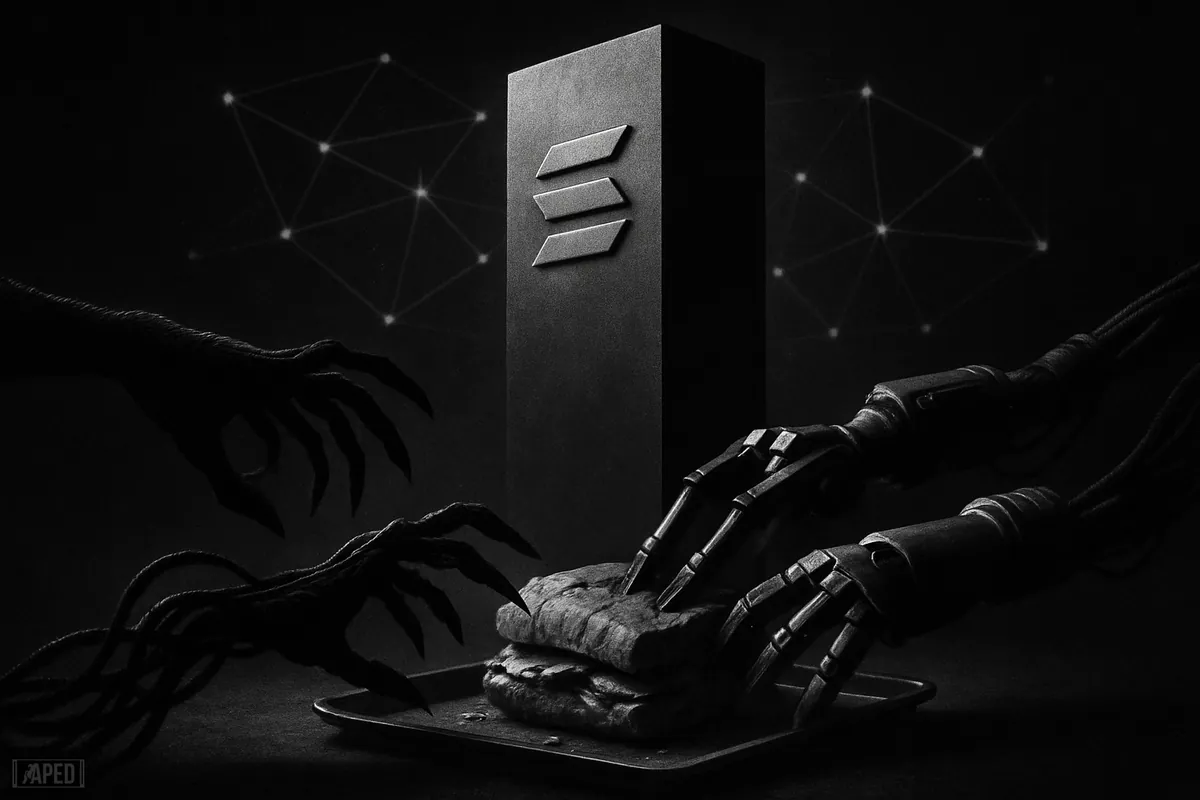
CT has spent years doing the same coping ritual: post a screenshot of a perfect sandwich attack, tag "MEV" like it is a natural disaster, then move on. Solana$76.56 researchers are now trying to make that meme harder to mint in the first place. This week, a new whitepaper proposed "Constellation," a protocol redesign that aims to limit validator discretion over transaction ordering and reduce maximal extractable value (MEV), the profit bots and validators can make by reordering or selectively including transactions. [1]
Constellation swaps Solana's current single-leader style block production (where one validator temporarily has outsized influence over what gets in, and in what order) for a multiple concurrent proposers (MCP) model. [2]
Instead of one leader effectively "owning" the moment, multiple proposers would submit transaction batches at the same time. A separate new role, attesters, would then verify and timestamp those submissions before the final block gets assembled. The leader does not disappear, but Constellation tries to box the leader in by forcing block contents to be anchored to what proposers submitted and what attesters confirmed.
The headline mechanic here is timing: the design introduces fixed "economic ticks" of roughly 50 milliseconds, creating a more predictable cadence for when transactions can be considered for inclusion. Predictability is doing a lot of work in this proposal, it is intended to narrow the wiggle room where front runs and reorder games usually live. [3]
Why this is aimed at MEV reduction, not just MEV "sharing"
Many MEV mitigations across crypto focus on who gets the MEV, not whether the MEV exists. Proposer-builder separation is the classic example: the system can become more transparent, but it often formalizes an MEV supply chain rather than shrinking it.
Constellation's pitch is different. By enforcing a rule set where valid, competitively priced transactions must be included within a defined window, the proposal attempts what the paper describes as selective censorship resistance. Translation for non-mega-nerds: validators should have fewer opportunities to "just wait," reorder, or quietly exclude transactions to set up profitable execution. [4]
The tradeoffs, and what could break in the real world
Solana$76.56 is basically saying it wants to look less like a raw speed demo and more like market infrastructure where execution is legible and fair. That is a cultural shift as much as a technical one.
The cost is complexity. Constellation introduces new coordination layers (proposers plus attesters plus the leader) and leans on tight timing assumptions, including clock synchronization. If those assumptions degrade under congestion, network jitter, or adversarial conditions, the fairness guarantees could get messy fast. Adding node roles can also introduce new incentive and centralization questions, especially around who runs attesters and why.
Practical takeaway: treat Constellation as a serious intentsignal, not a shipped fix. Watch for (1) whether this becomes a formal Solana improvement track with an implementation timeline, (2) testnet data showing the 50 millisecond tick model holds up under stress, and (3) how the ecosystem reacts, especially DEX teams and wallet builders who see MEV pain firsthand. [5]
If Solana can make ordering rules more enforceable at protocol level, front-running turns from an assumed tax into a solvable engineering problem. If not, CT gets its meme back, and users keep paying the invisible spread.
Listen to “Solana’s Constellation proposal aims to curb MEV front-running with multi-proposer blocks” on YouTube as we share all our news to our channel 24/7.
Be part of the conversation!
Discuss the "Solana Constellation Upgrade Targets MEV, Fair Ordering" article and follow us to get 24/7 updates.
Your reviews help us improve the quality of both current and future articles. All reviews are public and visible to other readers. We use both ratings and comments to improve future articles and to revise any articles that do not meet our standards.
 See more like this on Google