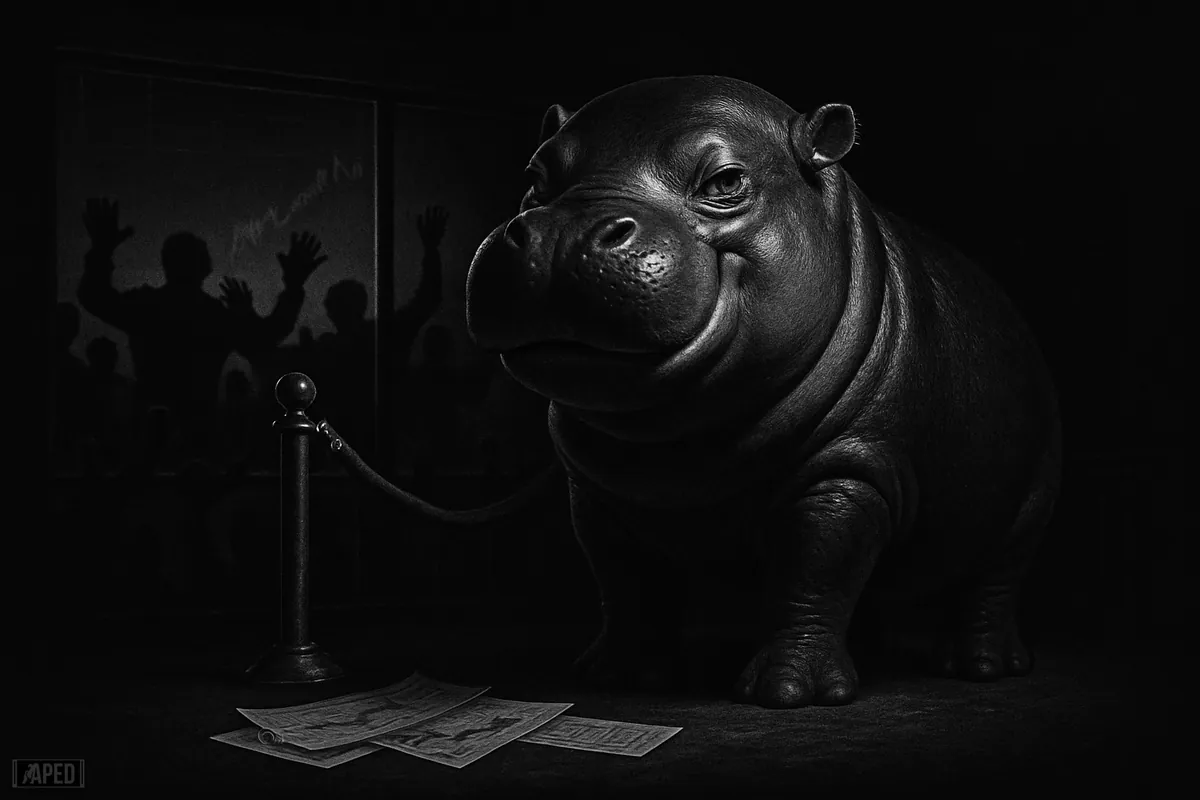
The market will apparently trade anything with a pulse, or in this case, a pygmy hippo. Moo Deng$0.04978Coin, a meme token tied to the viral animal sensation Moo Deng, jumped after news spread that a man was fined for entering the hippo's enclosure. Because of course a zoo incident now counts as a trading catalyst. [1]
Enjoy articles without ads?
Register for free and get unlimited access to all articles.
The move in MOODENG
MOODENG surged as traders latched onto fresh headlines around the animal that inspired the token. The price action fits the meme coin playbook almost too neatly: a burst of mainstream attention, a spike in speculative volume, then the usual question of whether anyone is left holding the bag once the internet moves on.
Additional reporting around the token suggests this is not the first time Moo Deng related headlines have sent the coin flying. Recent coverage tied the token to prior viral episodes, including a kidnapping scare or hoax involving the hippo, with some reports claiming gains of roughly 250% before a sharp reversal. That pattern matters more than the latest headline itself. The coin is trading less like an asset with fundamentals and more like a sentiment detector for one very famous animal. [2][3]
Why the enclosure fine mattered
A real world headline, a crypto reflex
The trigger this time was a widely shared story that a man entered Moo Deng's den or enclosure and was later fined. The incident sparked another wave of attention around the hippo, pushing the animal back into social feeds and news coverage. For meme coins, that is often enough. [4]
There is no obvious cash flow model to analyze here, and no protocol upgrade to price in. What traders are really buying is narrative velocity, meaning how fast and how far a story spreads online. A legal penalty tied to a beloved viral mascot is exactly the sort of absurd, highly clickable event that can light up speculative corners of crypto.
Meme beta, animal edition
Meme tokens often trade on cultural momentum rather than chain level utility. Moo Deng$0.04978 appears to be doing exactly that. The token's value proposition, if we are being generous, is proximity to internet attention. When that attention spikes, price follows. When it fades, liquidity tends to get thin fast.
That dynamic helps explain why these rallies can be violent and brief. A token linked to a single meme figure has concentrated narrative risk. If the mascot trends, great. If not, there is not much underneath the trade to catch the fall.
Context from the broader market
The jump also landed in a generally green crypto tape. Major assets were up, with Bitcoin$80,593.08 above $70,800 and Ethereum$2,367.04 above $2,190 in the cited market snapshot. A risk-on backdrop can amplify meme coin moves, especially in smaller tokens where relatively modest buying pressure can produce exaggerated percentage gains.
Still, broad market strength should not be confused with validation. A rising crypto market can lift low quality assets right alongside stronger ones. Meme traders know this. Many just prefer not to say it out loud while the chart is vertical.
Risks to consider
MOODENG's recent history, based on research references tied to earlier viral incidents, points to the usual boom-bust setup. Sudden triple digit gains can reverse just as quickly once social engagement cools or early buyers take profit. Thin liquidity, concentrated holdings, and headline dependence make these names especially fragile. [5]
There is also the uncomfortable reality that real world animal welfare incidents are becoming speculative inputs. That may be good for short term volume, but it is not exactly a durable foundation for a token economy.
What to watch next
The key question is whether Moo Deng$0.04978 can hold attention after the headline cycle fades. Traders should watch volume, wallet concentration, and whether exchange activity remains elevated over the next several sessions. If the token starts slipping on declining turnover, that would suggest the move was mostly a news driven reflex.
Your reviews help us improve the quality of both current and future articles. All reviews are public and visible to other readers. We use both ratings and comments to improve future articles and to revise any articles that do not meet our standards.
 See more like this on Google