See more like this on Google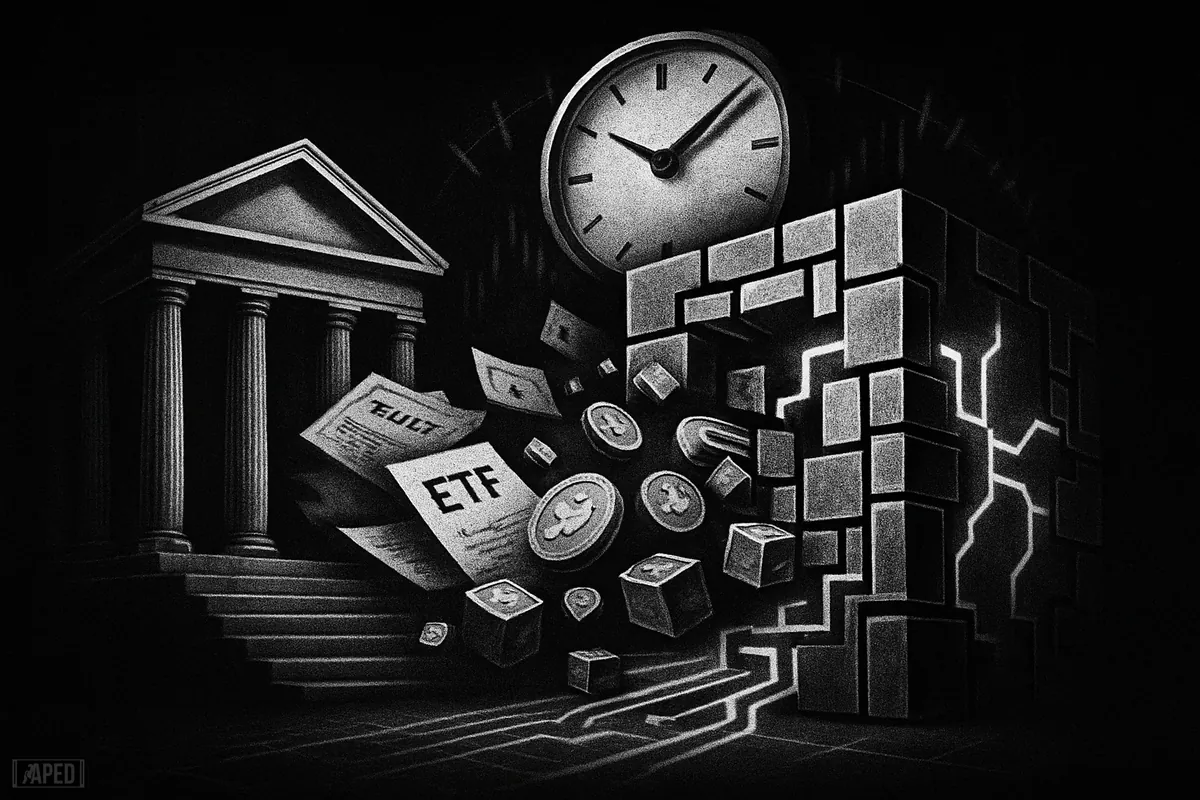
Share article
Share article
GM to everyone who's ever stared at a Sunday-night chart and thought, "Why does everything trade except stocks?" That gap is exactly what Ondo Finance and Franklin Templeton are trying to meme into irrelevance.
On Wednesday, Franklin Templeton, the asset manager with roughly $1.7 trillion in assets under management, backed Ondo's push to bring tokenized U.S. equities and ETFs onchain, aiming for 24/7 access through a new distribution and issuance effort tied to Ondo Global Markets. [1] [2]
Enjoy articles without ads?
Register for free and get unlimited access to all articles.
What Franklin Templeton and Ondo are actually building
The partnership centers on tokenized versions of traditional investment products, meaning blockchain tokens that are designed to be backed by real world securities such as stocks and exchange-traded funds. Ondo's role is the onchain infrastructure and issuance layer via Ondo Global Markets, while Franklin Templeton is positioned as a heavyweight supplier of products, plus a credibility engine for crypto-native users who want "real" exposure without leaving their wallet UX. [3]
The pitch is straightforward: let users access familiar market exposures using crypto rails, with tokens representing claims tied to underlying assets rather than purely native crypto instruments.
Why this matters, beyond the "TradFi finally noticed" narrative
Tokenized securities have been a recurring plotline on Crypto Twitter (CT), but this announcement lands differently because Franklin Templeton is not a boutique experimenter. It is a mainstream asset manager effectively signaling that the "onchain wrapper" is moving from curiosity to distribution strategy.
Two real implications stand out:
- 24/7 market access becomes a product feature, not a workaround. Crypto trades continuously, while U.S. equities remain bound to exchange hours. Tokenized equities attempt to turn that mismatch into an advantage for onchain venues, especially for global users who live outside U.S. market hours.
- Onchain finance gets a clearer bridge to regulated assets. For DeFi users, "RWA" (real world assets) often means T-bills or credit funds. Expanding the menu to stocks and ETFs is a different level of cultural crossover, with new use cases in collateral, hedging, and portfolio construction, assuming the legal rails hold.
The fine print: 24/7 tokens still live in a regulated world
The headline promise is continuous trading, but the hard part is everything around it: issuance, custody, investor eligibility, and regulatory compliance. Tokenized equities are not just a new UI, they sit directly in the path of securities law, broker-dealer rules, market surveillance expectations, and jurisdictional limits.
That creates a few practical constraints readers should keep in mind:
- Access may be gated. Even if a token sits in a wallet, distribution can require KYC, geographic restrictions, or investor qualification depending on structure.
- Liquidity is the whole game. "24/7" only matters if there is meaningful depth and tight spreads. Otherwise, it is a thin after-hours market with a nicer slogan.
- Redemption and backing mechanics matter more than vibes. For any tokenized stock or ETF exposure, users will want clarity on how the token remains aligned with the underlying asset, what happens during market closures, and what entities handle custody and settlement.
Competitive pressure is coming from both sides
Ondo is positioning itself as the onchain venue that can speak both languages: TradFi product sensibilities and crypto-native distribution. But it will be squeezed from two directions:
- Traditional finance already controls the underlying assets and the compliance perimeter, so incumbents can replicate token wrappers if demand proves durable.
- Crypto venues already own the 24/7 user experience, and many will try to list or build comparable exposures if regulators allow it.
Franklin Templeton's involvement does not solve those competitive dynamics, but it does raise the cost of ignoring them.
What to watch next (and what could break)
For readers tracking whether this becomes a real market or just a good headline, the next catalysts are concrete:
- Product specifics: which stocks and ETFs, which jurisdictions, and what eligibility rules apply.
- Market quality signals: onchain volume, active wallets, and whether liquidity looks organic or incentive-driven.
- Regulatory posture: any statements or guidance that clarify how tokenized equities are treated across U.S. and non-U.S. contexts.
- Operational transparency: custody setup, auditability of backing, and redemption pathways.
Takeaway: This is a serious validation moment for onchain equities because the sponsor is serious. Still, "24/7 onchain stocks" only becomes a usable product if compliance gates are clear and liquidity is real. Watch the implementation details, not the meme. [1]