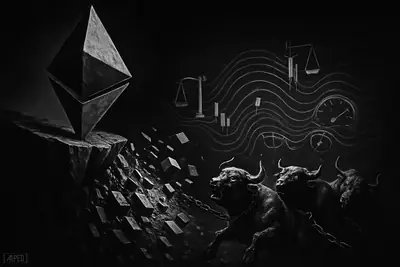
Liquidation maps are not prophecy, but they do show where the pain is parked. Right now, a lot of that pain sits just below Ethereum$2,327.64.
Ethereum$2,327.64 longs are facing a potential $1.4 billion wipeout if ETH slides under $2,040, according to liquidation heatmap data cited in recent market reporting. With ETH recently changing hands near $2,142, that puts the danger zone roughly 5 percent lower, close enough to matter and far enough to trigger real damage if momentum turns. [1]
Register for free and get unlimited access to all articles.
Why $2,040 matters
The level is important because it appears to hold a dense cluster of leveraged long positions. If Ethereum$2,327.64 breaks through it, exchanges would begin forcibly closing underwater bets, adding sell pressure into an already falling market. That is the classic liquidation cascade setup, the part where overleveraged bulls get rekt and price can overshoot to the downside. [2]
This is not a guarantee that ETH will tag $2,040. It is a map of conditional risk. Liquidation levels tend to attract attention because traders know where the crowded positioning sits, and crowded trades are where volatility usually gets loud.
A relatively small move could do outsized damage
From around $2,142 to $2,040, ETH would need to fall about $102. In crypto terms, that is not some black swan move. It is a routine bad day. What makes it dangerous is not the size of the spot move, but the leverage stacked underneath it.
When leverage builds up, the market becomes mechanically fragile. One flush can force liquidations, which pushes price lower, which triggers more liquidations. That feedback loop is why liquidation data matters more than narrative during choppy stretches.
The warning comes as digital assets remain highly reactive to macro swings and fast changes in derivatives positioning. Broader crypto markets have already seen large-scale liquidations across both bullish and bearish bets in recent sessions, a sign that traders are leaning hard and getting whipped around. [3]
ETH is also trading in a market where Bitcoin$80,333.45 direction still sets the tone. If BTC weakens, Ethereum often gets dragged with it, especially when open interest is elevated and traders are crowded on one side. In that environment, support levels are not just technical lines, they are liquidation tripwires. [4]
Support below support
Some research tied to the story points to nearby liquidation pressure beginning even slightly lower, around the low $2,020s. That matters because liquidation zones are not precise single ticks. They are bands. A break of $2,040 could therefore open the door to a broader pocket of forced selling rather than one clean event at one exact price. [5]
For traders, that means watching reaction speed as much as the level itself. A slow drift lower is one thing. A sharp rejection into that zone with rising volume is the nastier setup.
What bulls need to avoid
Bulls basically need ETH to stay comfortably above that cluster and reclaim upside momentum before shorts start pressing the weak spot. Holding above current levels reduces the immediate liquidation risk and can force late bears to back off. Losing momentum, by contrast, turns every bounce into exit liquidity.
None of this says Ethereum's larger market structure is broken. It says the derivatives side looks crowded enough that a modest spot decline could cause disproportionate damage in the short term. That distinction matters.
The $2,040 area is now a visible stress point for Ethereum. If it holds, the $1.4 billion liquidation threat stays theoretical. If it breaks, expect a fast test of how much leverage the market can puke out before buyers step in. For now, this is less about ideology and more about plumbing: too many longs, too close to the trapdoor.
Your reviews help us improve the quality of both current and future articles. All reviews are public and visible to other readers. We use both ratings and comments to improve future articles and to revise any articles that do not meet our standards.
 See more like this on Google