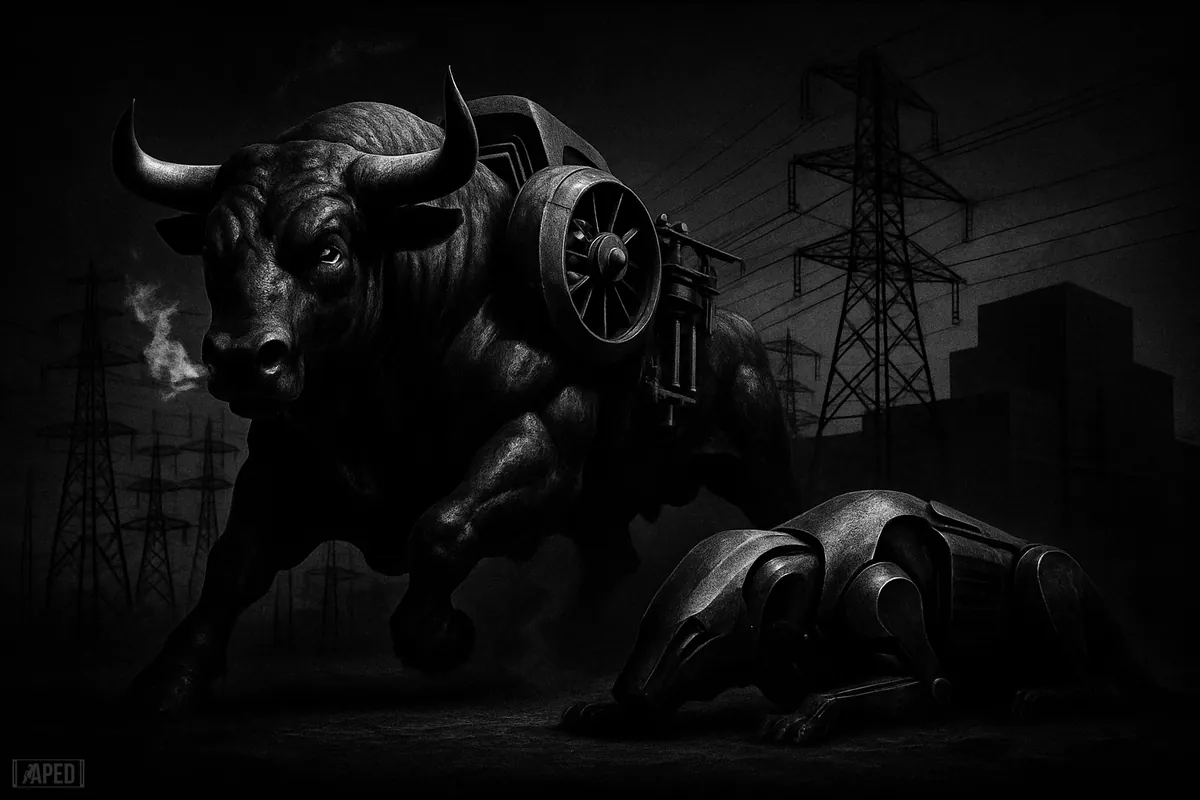
Energy has turned into one of 2026's cleanest rotation trades, up roughly 30% while the once-unstoppable AI equitybasket has gone flat. After two years of near one-way traffic into chipmakers, hyperscalers and anything with "AI" in the pitch deck, investors are starting to price a more awkward reality: intelligence at scale needs a lot of power, and power is suddenly the scarcer asset. [1]
Enjoy articles without ads?
Register for free and get unlimited access to all articles.
The trade has shifted from models to megawatts
The AI story has not broken. What has changed is where markets think the next layer of value sits.
Earlier phases of the rally were driven by semiconductor names, cloud providers and software firms tied to training and inference demand. That part of the market was repriced hard and fast. Valuations expanded on the assumption that AI spending would stay explosive and broad-based. By early 2026, that left many of the obvious winners looking fully valued, while earnings still had to catch up. [2]
Energy names, by contrast, started the year with lower expectations and more conventional multiples. As investors looked past the glamour end of AI and into the machinery needed to keep data centres running, utilities, power producers and broader energy infrastructure began to attract fresh capital. It is not as sexy as a new frontier model, but it is a proper bottleneck.
The main catalyst is straightforward: data centres are consuming more electricity, and planned AI capacity is forcing a rethink across the grid. Training large models is energy-intensive. So is serving them at scale. That has turned electricity supply from a background input into a strategic variable. [3]
Markets are now treating power generation and transmission as direct beneficiaries of AI expansion, not just adjacent industries. If hyperscalers want to keep building, they need dependable energy contracts, faster interconnection and more generation capacity. That links AI capex to parts of the market that had previously been ignored. [4]
Investors are rotating into what is still cheap
There is also a plain old valuation story here. The AI winners became crowded. Energy did not.
That matters in a market where investors are becoming less willing to pay any price for growth. A trade can stay good and still get tired. That seems to be the mood around AI stocks for now. The sector has not imploded, but the easy momentum has gone, and that often sends money hunting for the next under-owned theme.
Energy fits the bill. It offers cash flow, dividends in many cases, and a macro story that now overlaps with the AI buildout. For portfolio managers trying to stay exposed to the secular AI trend without paying nosebleed multiples, energy has become the less crowded expression. [5]
One point is worth keeping clear: the cooling in AI stocks does not mean the AI buildout is over. If anything, the energy rally is partly a second-order AI trade.
That distinction matters because markets often flatten nuance. Traders love a simple "AI is dead, energy is in" headline. Reality is messier. AI infrastructure demand still looks real, but the market is broadening out from the obvious names into the companies that enable the whole system to function.
That is a healthier setup than the earlier phase, when almost every rally in a mega-cap tech name was treated as proof that the entire theme had further to run. Some of that was justified. Some of it was a bit dodgy, driven more by multiple expansion than by fresh operating data. [6]
What this means for crypto investors
Crypto does not trade in a vacuum, and this shift matters because digital asset markets are highly sensitive to changes in macro leadership.
When equity markets reward hard-asset and infrastructure exposure over long-duration growth, it can alter risk appetite across the board. That does not automatically hurt Bitcoin$80,617.56 or high-beta tokens, but it can cool the speculative spillover that often comes from euphoric tech leadership. Fewer AI stock melt-ups usually means less reflexive enthusiasm for every AI-linked token on CT, short for Crypto Twitter.
There is another angle too. Bitcoin$80,617.56miners, power-market participants and tokenised infrastructure plays may receive renewed attention if investors keep following the energy-input side of the AI narrative. Not all of those themes will be investable, and some will be obvious narrative tourists. Still, the overlap between compute, power and digital assets is becoming harder to ignore.
The cleanest way this energy trade gets invalidated is if AI equities start reaccelerating on earnings while power names fail to convert the narrative into hard numbers. Markets will tolerate a story for a while, but not forever.
There is also the risk that energy's 2026 run becomes its own crowded trade. A 30% move in a few months can pull in fast money, and fast money has a habit of leaving just as quickly. If power demand projections soften, regulatory friction rises, or data centre buildouts slip, some of these stocks could give back gains sharply. [7]
The bigger picture
This rotation says more about market maturity than market panic. Investors are not abandoning AI. They are moving down the stack, from software magic to physical constraints.
That is usually what happens when a theme grows up. First the market buys the dream. Then it starts buying the plumbing. Right now, the plumbing is winning.
Your reviews help us improve the quality of both current and future articles. All reviews are public and visible to other readers. We use both ratings and comments to improve future articles and to revise any articles that do not meet our standards.
 See more like this on Google