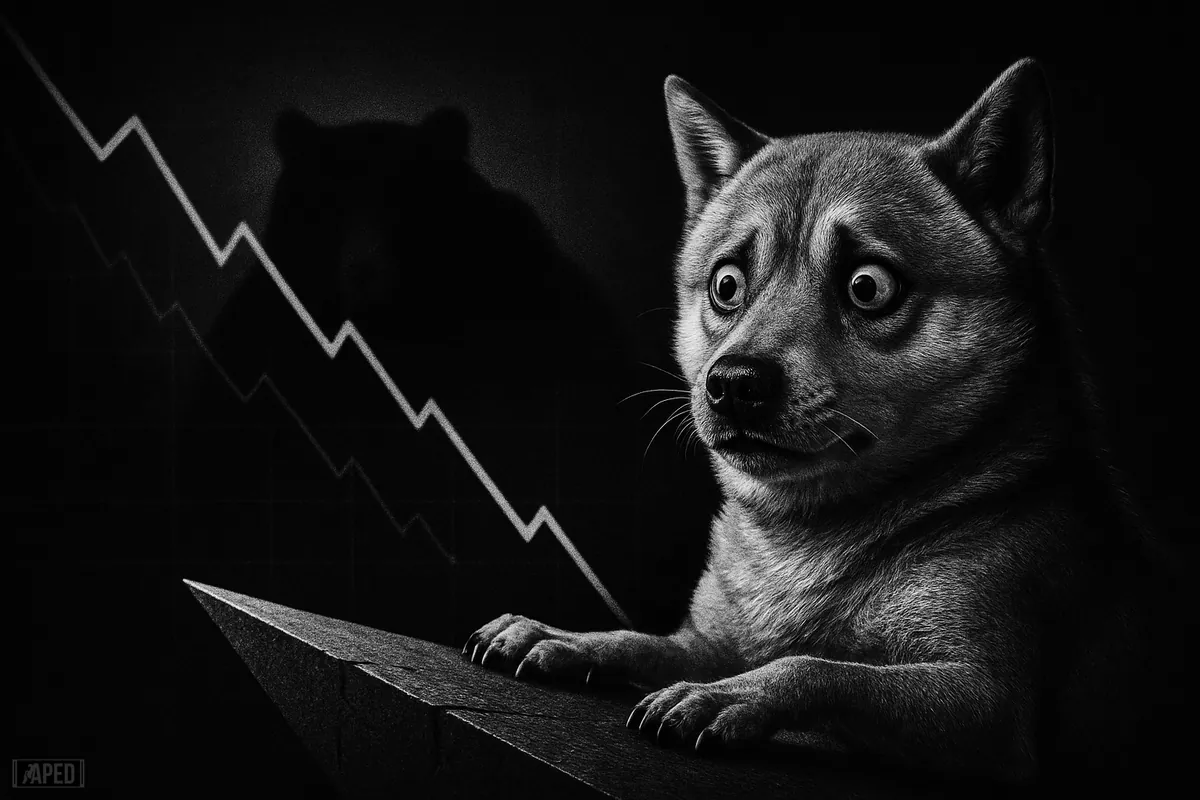
Dogecoin$0.09301 is leaning bearish again, and the setup is simple: price is compressing inside a triangle with lower highs, support is getting tested, and a breakdown could open a cleaner short than traders have seen in weeks. DOGE was recently trading around $0.092, down roughly 2% on the day in the source material, with the key line in the sand sitting near the low $0.09 area. [1]
That matters because triangle patterns are less about prediction and more about pressure. Dogecoin$0.09301 has failed to reclaim prior bounce highs while repeatedly revisiting support. If that floor gives way with volume, the trade shifts from chop to momentum, and late longs could become exit liquidity fast.
Register for free and get unlimited access to all articles.
The bearish case is technical, but the trigger is clear
The pattern forming on DOGE resembles a descending triangle, a structure that usually reflects persistent sellers pressing into a flat or near-flat support zone. In plain English, buyers are defending one area, but each rebound is getting weaker. [2]
For DOGE, that puts the spotlight on the $0.09 to $0.091 region. A clean break below that band would confirm the pattern far more than any intraday wick or brief flush. Traders looking for downside continuation would likely want to see a decisive move, not just a momentary dip that gets bought back.
Measured move targets from triangle breaks vary by timeframe, but the outside research around similar setups points to double-digit downside risk, with some projections ranging from the low teens to above 20% if support fully fails. That does not mean Dogecoin$0.09301 automatically nukes that far. It means the structure allows for that kind of move if momentum and broader market conditions line up. [3][4]
Why short setups in DOGE can get crowded
DOGE is one of the most reflexive large-cap meme coins in the market. That makes every obvious setup dangerous. A bearish pattern can break down and still rip higher later if Bitcoin$80,709.03 turns strong, if meme coin beta comes back, or if a sudden social catalyst hits the tape.
That is the main risk for bears here. If DOGE reclaims the descending trendline and starts printing higher lows instead of equal lows, the short thesis weakens fast. A squeeze through nearby resistance could trap overconfident shorts, especially in a market where meme names still trade heavily on sentiment rather than fundamentals.
The cleaner invalidation is straightforward: hold above support, reclaim overhead trend resistance, and convert that level into support on a retest. If that happens, the triangle stops looking bearish and starts looking like a failed breakdown setup, which often moves hard in the opposite direction.
The first thing to watch is whether DOGE closes below the current support shelf with real follow-through. A breakdown without expansion in volume can turn into chop. A breakdown with acceleration is a different story. [5]
The second thing is broader crypto risk appetite. DOGE rarely trades in a vacuum. If Bitcoin stays firm and majors stabilize, the meme complex can absorb bearish technicals longer than expected. If the market rolls over, DOGE's chart likely matters more, not less.
The third is positioning. While the source material focuses mostly on chart structure, the practical takeaway is that leverage building into a highly visible support break can create volatility in both directions. If too many traders pile into the same short, the first move lower may not be the easiest part of the trade to hold.
DOGE is compressing into a bearish-looking triangle, and $0.09 is the level that matters. Below it, the path opens to a sharper downside move and gives bears a clearer technical trigger. Above it, this remains just another meme coin fakeout waiting to happen.
For now, the chart favors caution over conviction. Watch the support break, watch whether sellers can hold it, and watch for any reclaim that would rekt late shorts. That is the trade.
Your reviews help us improve the quality of both current and future articles. All reviews are public and visible to other readers. We use both ratings and comments to improve future articles and to revise any articles that do not meet our standards.
 See more like this on Google