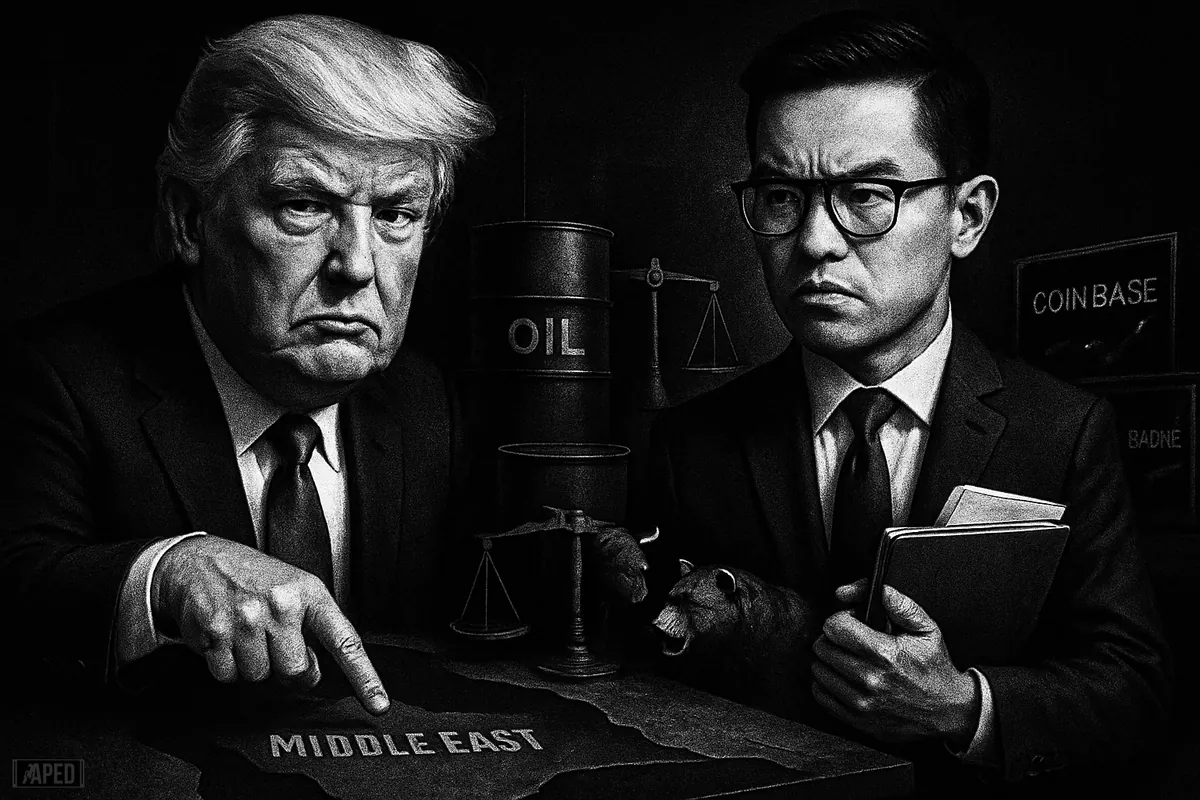
Bitcoin$80,329.04 and the wider crypto market are heading into Sunday with a proper macro overhang: President Donald Trump's April 6 deadline on Iran. Coinbase says the issue is not just headlines, it is the risk that an extended standoff keeps geopolitical stress priced into oil and, by extension, every risk asset trying to catch a bid. [1]
That matters because crypto has not been trading like some insulated parallel system lately. It has been trading like a levered macro asset with weekend liquidity, and that is often a dodgy mix when geopolitics starts moving energy markets.
Register for free and get unlimited access to all articles.
Coinbase flags a fragile setup
Coinbase global head of investment research David Duong warned this week that crypto sits in a "precarious position" as the deadline approaches. The core of the argument is straightforward: if tensions cool and some form of deal emerges, the oil risk premium could ease and markets may go back to trading growth, rates and liquidity. If the confrontation drags on or escalates, crude could spike again, recession fears could deepen and traders may keep cutting exposure across high-beta assets. [1]
That is the key distinction. This is less about one date magically deciding crypto's fate, more about whether the market has to reprice geopolitical risk for longer than it expected. Crypto tends to feel that repricing quickly because it trades around the clock and often becomes the first liquid thing people sell when uncertainty rises.
Oil has become the transmission channel
The cleanest way to read this setup is through oil. March already showed the pattern. Crude surged sharply, extending its year-to-date rally to roughly 78% according to the source data, while broader risk assets lost momentum. Bitcoin$80,329.04 initially held up better than some traders expected, but that resilience faded late in the month. [2]
By the time the move had played out, BTC was down more than 25% year to date. Ethereum$2,326.78 was hit even harder, falling about 34% and dragging altcoins lower with it. That relative weakness in ETH matters because it usually tells you the market is not in a healthy "risk on" rotation, it is in capital preservation mode with selective exits.
If oil jumps again on renewed threats to Iranian infrastructure or fears around regional supply, crypto likely feels the pressure through the same macro channel: tighter financial conditions, hotter inflation expectations, weaker growth assumptions and lower appetite for speculative positioning. [3]
On-chain and positioning data suggest traders are already less eager to press fresh longs here. One of the more telling signals is Bitcoin's Spent Output Profit Ratio, or SOPR, moving back toward 1 as BTC traded around the $68,000 area.
For non-chart goblins, SOPR near 1 means coins moving on-chain are being sold close to break-even. That tends to mark indecision. Holders who sat through drawdowns are no longer taking chunky profits, but they are also happy enough to exit when they can get out flat. It is not capitulation, but it is not conviction either.
That kind of flow can make the market brittle. If bad news hits while a large cohort of recent buyers is hovering around break-even, the temptation to de-risk rises fast. Weekend order books are rarely deep enough to absorb that smoothly.
Derivatives markets are echoing the same caution. According to options platformDerive, there has been stronger demand for downside protection into end-of-April expiry. Institutional traders do not always get the direction right, but they are usually quick to express what kind of risk they think is underpriced. [4]
Right now, they appear more interested in hedging a downside move than chasing upside exposure. That does not guarantee a sell-off. It does suggest the market is willing to pay for insurance, which usually happens when traders think a headline shock could hit before spot has fully priced it.
Open interest and leverage data were not included in the source material, but the broader read is familiar: when spot weakens, options skew turns defensive and macro headlines dominate, crypto becomes highly sensitive to any liquidation cascade. If traders on CT, short for Crypto Twitter, start treating every diplomatic headline as a tradeable catalyst, volatility can overshoot fundamentals very quickly.
What happens if the deadline passes cleanly?
There is still a relief case. Duong's view leaves room for a short-lived volatility event if Trump's projected timeline for the conflict, roughly two to three weeks, proves accurate and the market sees a path to de-escalation. Under that scenario, oil may stabilise, recession pricing could fade and crypto would likely revert to its usual macro drivers such as ETF flows, rate expectations and dollar liquidity. [5]
That would not instantly fix everything. Bitcoin is still trying to prove it can reclaim trend strength after losing momentum in March, and Ethereum remains structurally weaker than BTC. But a calmer geopolitical tape would at least remove one of the nastier exogenous risks hanging over the market.
The more bullish interpretation is that crypto has already absorbed a lot of bad news. Extreme fear has lingered across the market, and much of the fast money has already rotated out of weaker names. If no further escalation arrives, reflexive short covering could do the rest.
Why this weekend matters
The deadline lands at an awkward time for crypto because it collides with one of the market's oldest flaws: thin weekend liquidity. Traditional desks can step back, market depth shrinks and a single large move in oil, futures or related headlines can produce outsized swings in digital assets before broader markets reopen.
That leaves Bitcoin$80,329.04 in a fairly binary spot. If geopolitical stress fades, the market may rediscover macro fundamentals and stabilise. If energy shock risk increases, crypto is unlikely to be spared just because it is decentralised.
Coinbase's warning is not a call for panic, but it is a useful reminder that crypto is still tied to the real world in ways some traders prefer to ignore. The invalidation for the bearish case is simple: easing tensions, softer oil and a quick shift back toward normal macro pricing. If instead crude keeps ripping and break-even holders start dumping into thin liquidity, this market could get messy rather quickly.
Your reviews help us improve the quality of both current and future articles. All reviews are public and visible to other readers. We use both ratings and comments to improve future articles and to revise any articles that do not meet our standards.
 See more like this on Google