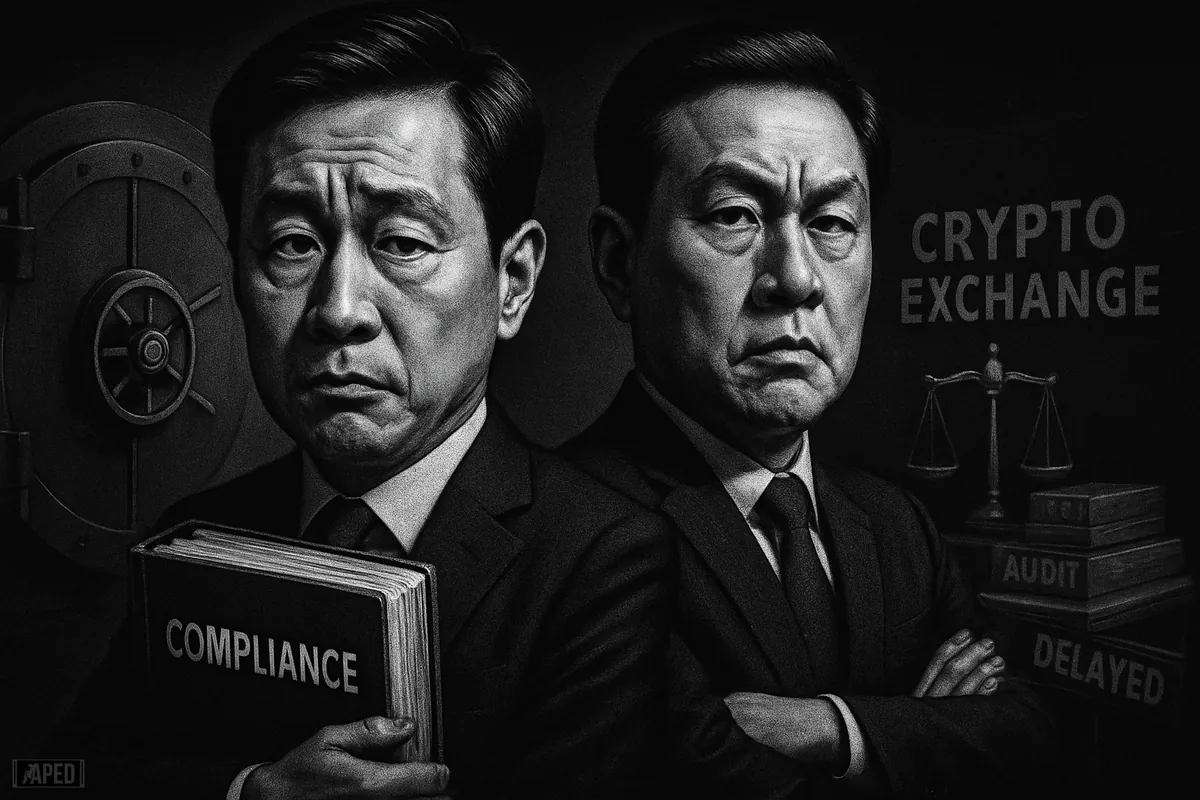
CT got another reminder that "soon" is one of the most flexible words in finance. Bithumb, one of South Korea's biggest crypto exchanges, has pushed its IPO timeline back again, from an earlier 2027 target to sometime after 2028. [1]
The shift was disclosed this week in South Korean media, alongside comments from CFO Jeong Sang-gyun that the company has signed an IPO advisory contract with Samjong KPMG and is now focused on tightening accounting policy and internal controls. The message is pretty clear: Bithumb still wants the listing, but it wants a cleaner runway first. [2]
Register for free and get unlimited access to all articles.
Why Bithumb is hitting pause
Bithumb is framing the delay as strategic rather than reactive. The company's explanation centers on maximizing corporate value while South Korea's digital asset rulebook is still evolving.
That matters because the country's proposed Framework Act on Digital Assets is expected to take shape in the second half of 2026. For any exchange trying to become a public market first mover, listing before the regulatory picture settles could mean pricing uncertainty, governance questions, and extra scrutiny from investors who are already allergic to avoidable surprises. [3]
The company is also signaling that this is not just a paperwork exercise. Stronger internal controls, cleaner accounting standards, and internal verification are exactly the kind of prep public market investors want to hear about, especially from a crypto venue. In plain English: Bithumb seems to be choosing a slower listing over a messy one.
Shareholders are not exactly in a GM mood
The delay lands awkwardly for investors who were already waiting for returns in a more old-school format: dividends.
Some shareholders have reportedly been pressing Bithumb to resume payouts, especially as performance improves. That complaint has become sharper because rival Dunamu, the operator behind Upbit, has been paying dividends, which gives Bithumb holders a very obvious comparison point. [4]
CEO Lee Jae-won's response was that the company prioritized retaining capital last year to defend and expand market share. Strategically, that is a recognizable move in a brutally competitive exchange market. Culturally, though, it creates tension. Shareholders hear "long-term value creation," but if no IPO is near and no dividend is flowing, patience starts to look less like conviction and more like forced staking.
The financial backdrop
Bithumb's latest approved financial report for its 12th fiscal year adds some texture to that debate. For 2025, the exchange reported total assets of about 3.3249 trillion won and liabilities near 2.461 trillion won. [5]
Those figures do not tell the entire story of operational strength, but they do show a company with meaningful scale and a balance sheet that public investors would examine closely. The issue is less whether Bithumb is large enough to list, and more whether it can list at the valuation and narrative it wants.
Market activity stays strong, even with the IPO on ice
Despite the listing delay, Bithumb is not exactly fading into irrelevance. Reported trading volume was around $523 million at the time of coverage, up 10.2% over 24 hours.
That kind of activity suggests the exchange still holds a meaningful place in Korea's crypto market structure. It also helps explain management's emphasis on corporate value: if the core business remains active, executives may feel they can afford to wait for a better listing window rather than rush into a discounted one.
Additional flow data points to another dynamic. CryptoQuant data indicated that more Bitcoin$80,593.08 was moving onto Bithumb than off it, a pattern often associated with elevated sell pressure because coins sent to exchanges are more readily available for trading. Bitcoin$80,593.08's relatively sideways behavior during that period suggested the market was absorbing that pressure without a clean breakdown, a small but useful signal that sentiment was mixed rather than panicked.
The $43 billion mistake still hangs over the story
There is also the part nobody can really meme away: Bithumb was recently tied to an investigation after an accidental transfer of roughly $40 billion to $43 billion worth of Bitcoin$80,593.08 to customers, depending on the report cited. [6]
Even if the incident was operational rather than existential, it is exactly the kind of headline that makes an exchange revisit its public market timing. Listing plans and internal control reviews tend to become much more serious after a giant error turns into a national news event. [7]
For prospective investors, this is not just about one mishap. It raises broader questions about process discipline, risk management, and whether a crypto exchange can translate trading success into public-company reliability. Public markets can tolerate volatility. They are much less forgiving about preventable control failures.
Why the timeline matters
Pushing an IPO past 2028 is more than a calendar tweak. In crypto years, that is a different era. Regulatory frameworks may change, market share leaders can rotate, and the valuation logic for exchanges can shift depending on fees, token listings, compliance costs, and retail trading appetite.
Bithumb appears to be betting that waiting will produce a stronger listing case. That could prove smart if South Korea's rules become clearer and the company can show cleaner governance plus steadier shareholder relations. It could also backfire if competitors strengthen their lead while Bithumb stays private and defensive.
Why It Matters
This story is less about delay for delay's sake and more about what public readiness now means for crypto firms. A few years ago, "we're going public" sounded like a flex. In 2026, the real flex is proving you can survive regulation, operational scrutiny, and shareholder pressure at the same time.
For readers, the practical takeaway is simple: watch three things. First, how South Korea's digital asset framework develops in the second half of this year. Second, whether Bithumb restores dividends or offers another path to placate investors. Third, whether the exchange can move past its operational missteps without another unforced error. If those pieces line up, the delayed IPO may look disciplined. If not, "after 2028" may end up reading less like strategy and more like stall.
Your reviews help us improve the quality of both current and future articles. All reviews are public and visible to other readers. We use both ratings and comments to improve future articles and to revise any articles that do not meet our standards.
 See more like this on Google