See more like this on Google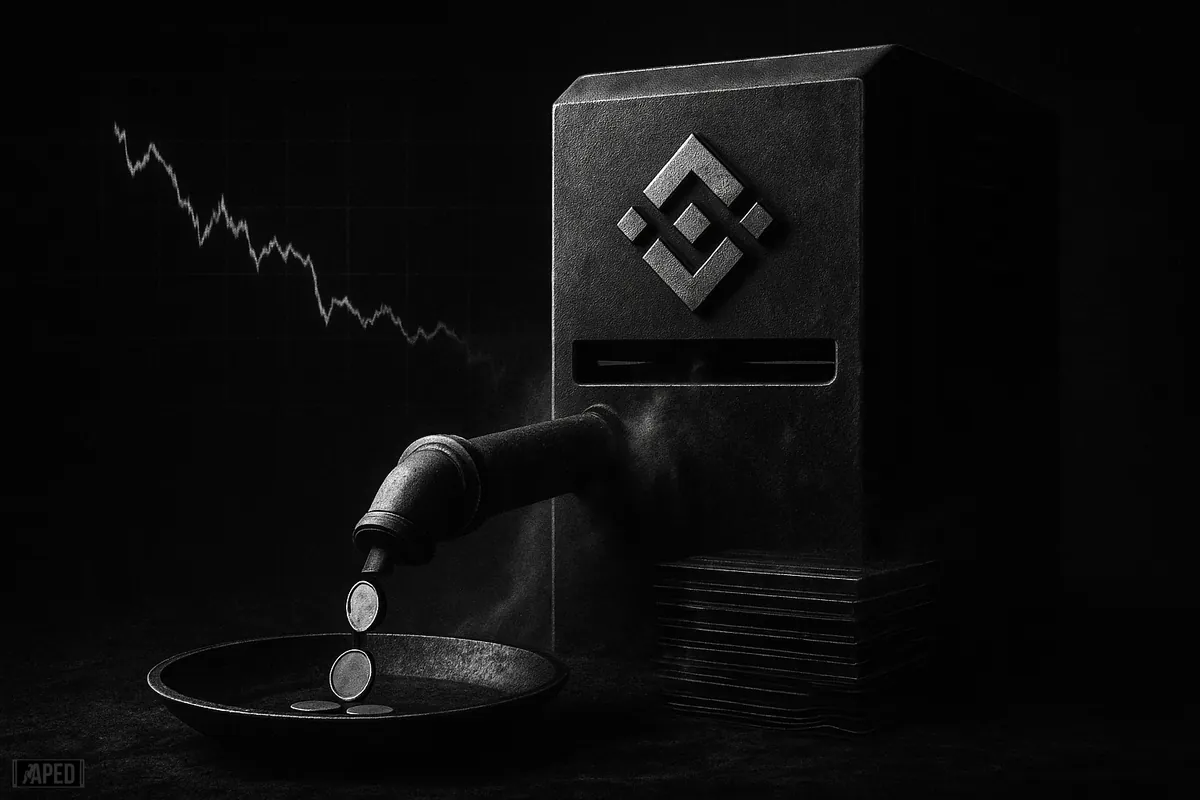

Share article
Share article
Enjoy articles without ads?
Register for free and get unlimited access to all articles.
Binance spot volume hits the floor, while BTC keeps moving
What the tape is signalling: participation is narrowing
- Thinner order books: less resting liquidity means larger market orders push price further. That can make breakouts look cleaner than they really are.
- More stop-driven moves: with fewer genuine spot buyers and sellers, short-term price discovery leans harder on liquidations and stop runs.
- More "tourist" flow: the kind that arrives late, takes a quick scalp, then disappears, rather than building sustained positioning.
Derivatives may be doing the heavy lifting
Even without pinning to a single datapoint, the framework is simple:
- If open interest is rising or stable while spot volume falls, you are watching leverage carry the market.
- If funding rates stay muted, it can mean positioning is more balanced, or that traders are rotating exposures quickly rather than sitting in crowded longs.
- If funding spikes positive on thin spot, you are in the danger zone for a squeeze-driven reversal, because the market is paying up to stay long without spot backing it.
This is where the degen lesson applies: leverage can move price, but it is a dodgy foundation if spot doesn't confirm.
Why Binance spot could be drying up
Several forces can produce "multi year low" spot volume without implying BTC is dead:
1) Flow fragmentation across venues
Binance is no longer the only serious pool of BTC liquidity. A growing share of activity can migrate to other centralised exchanges, prime broker routes, and region-specific venues depending on fees, access, and compliance constraints.
2) Structural shift toward passive exposure
When the market leans into longer-horizon BTC exposure, the churn shifts away from exchange spot and into products designed for holding rather than trading. That reduces the kind of constant two-way spot activity Binance used to dominate.
3) Traders preferring perps over spot
Perps offer capital efficiency and simpler shorting. If the market is chopping, it is common to see spot volumes fade while derivatives remain active, especially among active traders who would rather express a view with leverage and tight risk.
4) A "quiet bull" can still be a bull
Paradoxically, some of the strongest grind-ups happen on declining volume, because sellers get exhausted and incremental bids face less resistance. That does not mean it is healthy, it means it is fragile.
What would confirm this is more than just a slow week
If Binance spot is truly at multi year lows, the next step is checking whether the weakness is Binance-specific or market-wide: [5]
- Cross-exchange spot share: if Binance is down but others are up, it is venue rotation. If everyone is down, it is a participation problem.
- Order book depth at key levels: if depth is also compressed, expect sharper wicks and more slippage.
- Net flows into exchanges: if there is no meaningful inflow of BTC to sell into strength, rallies can persist, but they also become prone to sudden air pockets when demand pauses.
What to watch next
- Spot volume recovery on up-days: the cleanest confirmation of real demand is rising spot volume during breakouts, not just during dumps.
- Derivatives heat: watch for rising open interest paired with positive funding on falling spot volume. That combination often precedes a long squeeze.
- Liquidity conditions: if order book depth continues to thin, expect more violent reactions around macro headlines and large on-chain transfers.