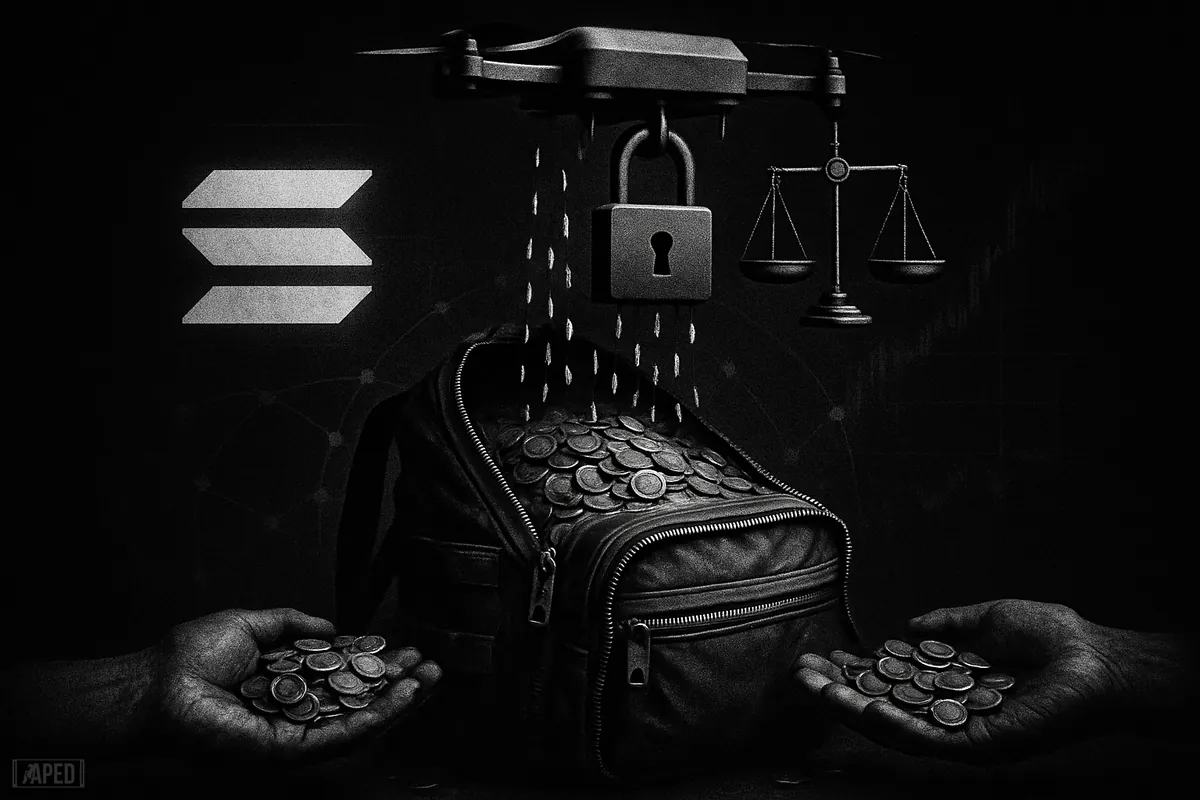
CT has been begging for "no insiders" token launches like it is 2021 again. Backpack just took the dare: the Solana$76.56-native exchange rolled out its Backpack$0.1544 token on Monday, March 23, 2026, pairing a 25% airdrop with a structure that tries to sidestep the usual "team dumps on day one" discourse. [1]
Backpack's token generation event (TGE, the moment a token is minted and becomes live for distribution and trading) puts Backpack$0.1544's total supply at 1 billion, with about 250 million tokens going out immediately to users. [2]
Register for free and get unlimited access to all articles.
What launched, and who gets the first 25%
Backpack says 25% of BP is being distributed at launch, primarily via an airdrop to existing users. The biggest share is directed to participants in Backpack's points program (the loyalty style system many exchanges use to track activity and reward engagement), with a smaller allocation reserved for other community cohorts tied to the platform. [3]
That split matters because points-based airdrops tend to attract two very different behaviors at once: genuine power users who want governance or long-term upside, and short-term "airdrop farmers" whose only plan is to claim and market-sell. Early chatter across Solana circles has reflected that familiar tension, with some users celebrating the size of the user allocation, while others focus on the likely sell pressure once claims open.
The headline twist: "no insider allocation" at inception
Backpack is explicitly marketing this drop as having no insider allocation at inception, a phrase that is doing a lot of work in 2026. [4]
In practical terms, it is a signal about timing and optics: insiders are not positioned to receive liquid tokens the moment BP hits the market. After a long cycle of token launches where "fair" distributions still ended with heavy early unlocks for private rounds, the framing here is designed to reassure users that the first wave is not a VC exit liquidity event.
The caveat, of course, is that "no insiders at inception" does not mean "no insiders ever." It means the rest of the supply is handled through lockups and milestone logic rather than day-one liquidity.
What happens to the other 75%: lockups, milestones, and an IPO hook
Backpack's remaining BP supply is set to be locked long-term, with releases tied to company milestones and even a potential IPO. That is a notable departure from the vanilla "X% team, Y% investors, Z% ecosystem" playbook, because it links token unlocks to offchain corporate events and execution targets rather than a simple linear vesting schedule. [5]
Most eye-catching is a provision that allows long-term stakers (users who lock tokens to support the network or platform and potentially earn rewards) to convert tokens into equity under certain conditions. Tokens-to-equity bridges are rare at scale because they collide with regulatory and corporate structure realities fast. Even so, the mere inclusion is a loud message about intent: Backpack wants BP to read less like a fleeting rewards point and more like a long-duration claim on the business's trajectory. [6]
For traders, this structure also changes the usual TGE calculus. If meaningful supply stays locked behind milestones, circulating supply dynamics could look tighter than launches where unlocks begin clocking immediately, though liquidity can still be volatile depending on how many airdrop recipients sell.
Why Solana, and why now
BP launching on Solana$76.56 is not a surprise given Backpack's positioning as a Solana-based exchange and wallet ecosystem. What is timely is the way projects are competing on distribution credibility as much as product. Users have gotten allergic to tokenomics that feel like a backdoor cap table, and "25% to users, insiders not live" is a clean headline for a market that has been punishing obvious extraction.
This also lands as exchanges keep experimenting with hybrid models: part consumer app, part onchain community, part quasi-public company narrative. Backpack is leaning into that blend explicitly.
Practical takeaway: what to watch next (and what can go wrong)
Three near-term catalysts will shape how BP trades and how the community feels about it:
Claim mechanics and eligibility clarity. Watch for friction: geographic restrictions, KYC requirements, claim windows, and whether points distributions match user expectations.
Actual circulating supply and sell pressure. A 25% airdrop sounds huge, but the market impact depends on how much becomes liquid immediately and how concentrated the airdrop is across wallets.
Details on staking and equity conversion. The equity pathway is intriguing, but the fine print will matter: lock durations, conversion terms, and any limitations that could make it more narrative than utility.
Risks are straightforward: airdrop-driven volatility, confusion over vesting and lockups, and the regulatory complexity implied by any equity-adjacent mechanism. If you are holding a bag, the cleanest next step is boring but effective: read the unlock schedule, confirm your eligibility, and treat day-one price action like a sentiment poll, not a verdict.
Listen to “Backpack launches BP token on Solana with 25% airdrop and no insiders at inception” on YouTube as we share all our news to our channel 24/7.
Be part of the conversation!
Discuss the "Backpack BP Token Launches on Solana, 25% Airdrop, No Insiders" article and follow us to get 24/7 updates.
Your reviews help us improve the quality of both current and future articles. All reviews are public and visible to other readers. We use both ratings and comments to improve future articles and to revise any articles that do not meet our standards.
 See more like this on Google